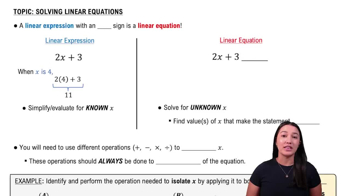
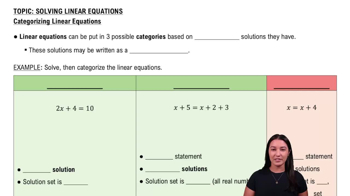
Isolate the variable by performing inverse operations to both sides until the variable stands alone.
What is the first step to solve equations that lead to linear equations?
Simplify the equation by expanding, combining like terms, or factoring to reduce it to a linear form.
How do you solve quadratic equations by factoring?
Rewrite the quadratic in factored form, set each factor equal to zero, then solve for the variable.
What does completing the square involve?
Rewrite a quadratic equation in the form \((x+p)^2=q\) by adding a constant to both sides.
How do you solve a quadratic equation by completing the square?
Convert the quadratic to a perfect square trinomial, then take the square root of both sides and solve for the variable.
What is the quadratic formula used for?
To find the roots of any quadratic equation \(ax^2+bx+c=0\) using \(x=\frac{-b\pm\sqrt{b^2-4ac}}{2a}\).
How do you solve quadratic equations using the square root property?
Isolate the squared term, then take the square root of both sides, remembering to include ± for two solutions.
How are quadratic equations solved in the complex number system?
Use the quadratic formula; if the discriminant is negative, express solutions with imaginary unit \(i\).
What is a radical equation quadratic in form?
An equation where a variable is under a root and can be rewritten as a quadratic by substitution.
How do you solve radical equations by factoring?
Isolate the radical, square both sides to eliminate it, then factor the resulting quadratic and solve.
What is interval notation used for in inequalities?
To express the solution set of inequalities as intervals on the number line.
What are key properties of inequalities?
You can add, subtract, multiply, or divide both sides by the same positive number without changing the inequality direction; multiplying/dividing by a negative reverses it.
How do you solve combined inequalities?
Solve each inequality separately and find the intersection (and) or union (or) of their solution sets.
How do you solve equations involving absolute value?
Set up two separate equations: one with the expression inside equal to the positive value, one equal to the negative value.
How do you solve inequalities involving absolute value?
Rewrite as two inequalities without absolute value, considering cases for less than or greater than.
What is the distance formula?
Distance between points \((x_1,y_1)\text{ and }(x_2,y_2)\) is \(\sqrt{(x_2-x_1)^2+(y_2-y_1)^2}\).
What is the midpoint formula?
Midpoint between points \((x_1,y_1)\text{ and }(x_2,y_2)\) is \(\left(\frac{x_1+x_2}{2},\frac{y_1+y_2}{2}\right)\).
How do you translate verbal descriptions into mathematical expressions?
Identify variables, keywords, and relationships, then write corresponding algebraic expressions or equations.
How do you solve interest problems in precalculus?
Use formulas for simple or compound interest and set up equations based on given conditions.
How do you solve mixture problems?
Set up equations based on the amounts and concentrations of components being mixed.
How are distance and midpoint formulas used in problem solving?
Apply them to solve problems involving geometry, interest, or mixtures that relate to points on a coordinate plane.
 Back
 04:02