What is the general form of an exponential function?
An exponential function has the form \(f(x) = b^x\) where b is a positive constant, b > 0 and b \(\neq\) 1, and x is the independent variable.
What is the natural base e and its approximate value?
e is an irrational number approximately equal to 2.71828, discovered by Bernoulli in 1683, and is the base of the natural exponential function.
What is the natural exponential function?
The natural exponential function is \(f(x) = e^x\), where e is Euler's constant.
What are the domain and range of exponential functions with base b > 1?
Domain: \((-\infty, \infty)\), Range: \((0, \infty)\). The graph passes through (0,1) and has a horizontal asymptote at y=0.
What are the domain and range of exponential functions with 0 < b < 1?
Domain: \((-\infty, \infty)\), Range: \((0, \infty)\). The graph passes through (0,1) and has a horizontal asymptote at y=0, but the function is decreasing.
What is the formula for compound interest compounded n times per year?
\(A = P \left(1 + \frac{r}{n}\right)^{nt}\), where A is the amount, P is the principal, r is the annual interest rate, n is the number of compounding periods per year, and t is time in years.
What is the formula for continuously compounded interest?
\(A = Pe^{rt}\), where A is the amount, P is the principal, r is the annual interest rate, and t is time in years.
What is the inverse function of an exponential function \(f(x) = b^x\)?
The inverse is the logarithmic function \(f^{-1}(x) = \log_b x\), which answers the question: to what power must b be raised to get x?
What is the domain of a logarithmic function \(f(x) = \log_b x\)?
The domain is all positive real numbers: \((0, \infty)\). The argument of the log must be positive.
Write the logarithmic equation \(\log_b x = y\) in exponential form.
The equivalent exponential form is \(b^y = x\).
Write the exponential equation \(b^y = x\) in logarithmic form.
The equivalent logarithmic form is \(\log_b x = y\).
What is the value of \(\log_b 1\) for any base b?
\(\log_b 1 = 0\) because \(b^0 = 1\).
What is the value of \(\log_b b\) for any base b?
\(\log_b b = 1\) because \(b^1 = b\).
What is the common logarithm?
The common logarithm is the logarithm with base 10, written as \(\log x\) or \(\log_{10} x\).
What is the natural logarithm?
The natural logarithm is the logarithm with base e, written as \(\ln x\).
Evaluate \(\log_4 16\) without a calculator.
Since \(4^2 = 16\), \(\log_4 16 = 2\).
Evaluate \(\log_{10} 100\) without a calculator.
Since \(10^2 = 100\), \(\log_{10} 100 = 2\).
Evaluate \(\log_2 1/4\) without a calculator.
Since \(2^{-2} = 1/4\), \(\log_2 \frac{1}{4} = -2\).
Find the domain of \(f(x) = \log_2 (x + 9)\).
Set the argument > 0: \(x + 9 > 0 \Rightarrow x > -9\). Domain: \((-9, \infty)\).
Find the domain of \(f(x) = \ln (5 - x)\).
Set the argument > 0: \(5 - x > 0 \Rightarrow x < 5\). Domain: \((-\infty, 5)\).
 Back
Back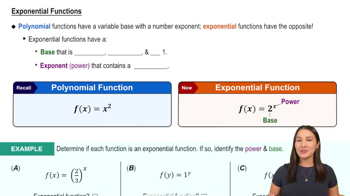
 6:13
6:13