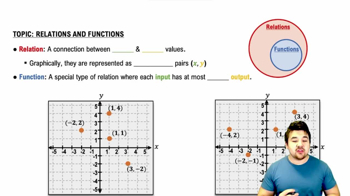
A function is a mathematical relation that maps each input value to exactly one output value.
What is the domain of a function?
The domain is the set of all input values of a function, represented by the x variable.
What is the range of a function?
The range is the set of all output values of a function, represented by the y variable.
When is a function positive or negative based on its graph?
A function is positive when its graph lies above the x-axis (outputs > 0), and negative when it lies below the x-axis (outputs < 0).
What are the four mathematical representations of functions?
Functions can be represented graphically, analytically (equations), numerically (tables), and verbally.
What does it mean for a function to be increasing on an interval?
A function is increasing if as input values increase, output values also increase: if \(a
What does it mean for a function to be decreasing on an interval?
A function is decreasing if as input values increase, output values decrease: if \(af(b)\).
What is the difference between a function increasing and its rate of change increasing?
A function increasing means outputs rise as inputs rise; the rate of change increasing means the slope itself is increasing (function is concave up).
What is the meaning of 'rate of change' in this course?
'Rate of change' means the slope of the function. It describes how output values change relative to input values.
What is a point of inflection on a graph?
A point of inflection is where the graph changes concavity, from concave up to concave down or vice versa.
What are vertical and horizontal asymptotes?
Vertical asymptotes are lines where the function approaches infinity; horizontal asymptotes describe the end behavior of the function as input approaches infinity or negative infinity.
What does it mean for a function to be even or odd?
An even function satisfies \(f(-x)=f(x)\); an odd function satisfies \(f(-x)=-f(x)\).
What is a one-to-one function?
A function is one-to-one if each output corresponds to exactly one input; its inverse is also a function.
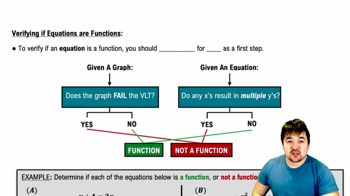
What is the vertical line test used for?
The vertical line test determines if a graph represents a function by checking if any vertical line intersects the graph more than once.
How do vertical translations affect a function graph?
A vertical translation shifts the graph up or down by \(k\) units: \(g(x)=f(x)+k\).
How do horizontal translations affect a function graph?
A horizontal translation shifts the graph left or right by \(h\) units: \(g(x)=f(x+h)\) shifts left by h.
What is vertical dilation of a function?
Vertical dilation stretches or compresses the graph vertically by a factor \(a\): \(g(x)=af(x)\).
What is horizontal dilation of a function?
Horizontal dilation stretches or compresses the graph horizontally by a factor \(1/b\): \(g(x)=f(bx)\).
What happens when \(a<0\) in vertical dilation?
If \(a<0\), the graph is reflected across the x-axis.
What happens when \(b<0\) in horizontal dilation?
If \(b<0\), the graph is reflected across the y-axis.
How do transformations inside the function argument affect the graph?
Transformations inside the parentheses affect the x-values and do the opposite of what they look like (e.g., \(x+h\) shifts left).
How do transformations outside the function argument affect the graph?
Transformations outside the parentheses affect the y-values and do exactly what they look like (e.g., \(f(x)+k\) shifts up by k).
What is the relationship between a function and its inverse graphically?
The graph of a function and its inverse are reflections of each other over the line \(y=x\).
 Back
Back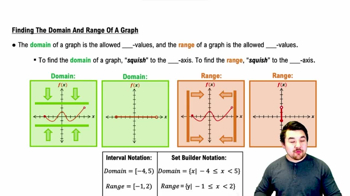
 5:10
5:10