Skip to main content
Precalculus
My Course
Learn
Exam Prep
AI Tutor
Study Guides
Flashcards
Explore
Try the app
My Course
Learn
Exam Prep
AI Tutor
Study Guides
Flashcards
Explore
Try the app
Back
Precalculus: Linear Functions, Equations, and Inequalities
You can tap to flip the card.
What is the general form of a linear function?
You can tap to flip the card.
👆
What is the general form of a linear function?
A linear function is generally written as \(y=mx+b\), where
m
is the slope and
b
is the y-intercept.
Track progress
Control buttons has been changed to "navigation" mode.
1/19
Recommended videos
Guided course
04:02
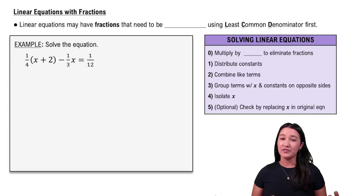
Solving Linear Equations with Fractions
2726
views
113
rank
1
comments
Guided course
07:48
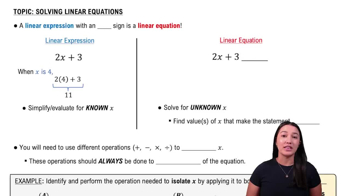
Introduction to Solving Linear Equations
5179
views
194
rank
2
comments
Guided course
06:00
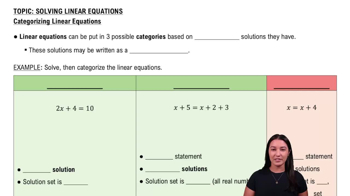
Categorizing Linear Equations
2360
views
78
rank
Terms in this set (19)
Hide definitions
What is the general form of a linear function?
A linear function is generally written as \(y=mx+b\), where
m
is the slope and
b
is the y-intercept.
How do you find the slope of a line given two points?
The slope
m
is calculated by \(m=\frac{y_2 - y_1}{x_2 - x_1}\).
What does the slope of a line represent?
The slope represents the
rate of change
or how much y changes for a unit change in x.
How do you write the equation of a line in point-slope form?
Point-slope form is \(y - y_1 = m(x - x_1)\), where
m
is slope and
(x_1, y_1)
is a point on the line.
What is the slope-intercept form of a linear equation?
Slope-intercept form is \(y = mx + b\), where
m
is slope and
b
is the y-intercept.
How do you find the y-intercept of a line?
The y-intercept is the point where the line crosses the y-axis, found by setting \(x=0\) in the equation.
What is the standard form of a linear equation?
Standard form is \(Ax + By = C\), where
A
,
B
, and
C
are integers and
A
≥ 0.
How do you solve a linear equation?
Isolate the variable by performing inverse operations to both sides until the variable is alone.
What is a linear inequality?
A linear inequality is like a linear equation but uses
<
,
>
,
≤
, or
≥
instead of
=
.
How do you graph a linear inequality?
Graph the boundary line (solid for ≤ or ≥, dashed for < or >), then shade the region that satisfies the inequality.
What happens to the inequality when you multiply or divide by a negative number?
You must
reverse the inequality sign
when multiplying or dividing both sides by a negative number.
How do you determine if a point satisfies a linear inequality?
Substitute the point's coordinates into the inequality; if true, the point satisfies the inequality.
What is the relationship between parallel lines and their slopes?
Parallel lines have
equal slopes
but different y-intercepts.
What is the relationship between perpendicular lines and their slopes?
Perpendicular lines have slopes that are
negative reciprocals
of each other.
How do you write the equation of a line parallel to a given line through a point?
Use the slope of the given line and the point in point-slope form: \(y - y_1 = m(x - x_1)\).
How do you write the equation of a line perpendicular to a given line through a point?
Use the negative reciprocal of the given line's slope and the point in point-slope form.
What is the intercept form of a linear equation?
Intercept form is \(\frac{x}{a} + \frac{y}{b} = 1\), where
a
and
b
are x- and y-intercepts.
How do you convert from standard form to slope-intercept form?
Solve for y: \(y = -\frac{A}{B}x + \frac{C}{B}\).
What is the solution set of a linear inequality?
The solution set is all points in the coordinate plane that make the inequality true.
 BackBack
 04:02