Skip to main content
Precalculus
My Course
Learn
Exam Prep
AI Tutor
Study Guides
Flashcards
Explore
Try the app
My Course
Learn
Exam Prep
AI Tutor
Study Guides
Flashcards
Explore
Try the app
Back
Precalculus: Relations and Functions
You can tap to flip the card.
What is a relation in mathematics?
You can tap to flip the card.
👆
What is a relation in mathematics?
A
relation
is any set of ordered pairs.
Track progress
Control buttons has been changed to "navigation" mode.
1/20
Recommended videos
5:10
Finding the Domain and Range of a Graph
3295
views
125
rank
1
comments
5:38
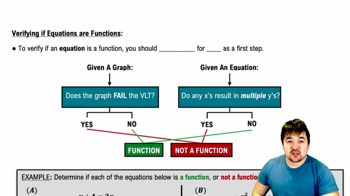
Verifying if Equations are Functions
3626
views
148
rank
3
comments
5:20
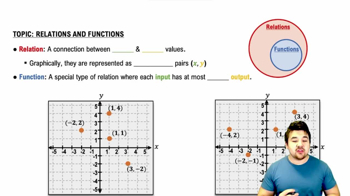
Relations and Functions
7525
views
292
rank
Terms in this set (20)
Hide definitions
What is a relation in mathematics?
A
relation
is any set of ordered pairs.
Define the domain of a relation.
The
domain
is the set of all first components (x-values) of the ordered pairs.
Define the range of a relation.
The
range
is the set of all second components (y-values) of the ordered pairs.
What makes a relation a function?
A relation is a
function
if each element in the domain corresponds to exactly one element in the range.
How can you identify a function from a set of ordered pairs?
If no x-value repeats with different y-values, the set is a function.
What is the Vertical Line Test?
If any vertical line intersects a graph more than once, the graph does not represent a function.
How do you evaluate a function at a given value?
Substitute the given value for x in the function's expression and simplify.
What is the difference between independent and dependent variables in a function?
The
independent variable
(x) can be any value; the
dependent variable
(y or f(x)) depends on x.
How is function notation written?
Function notation is written as \(f(x)\), representing the output for input x.
What does the domain represent on a graph?
The domain is the set of all x-values (inputs) shown on the graph.
What does the range represent on a graph?
The range is the set of all y-values (outputs) shown on the graph.
How is interval notation used for domain and range?
Square brackets [ ] include endpoints; parentheses ( ) exclude endpoints; parentheses are used with infinity.
What does it mean if an equation solved for y gives more than one y for a given x?
The equation is
not a function
.
Is the equation \(x + y = 4\) a function?
Yes, y can be expressed as y = 4 - x, which gives one y for each x.
Is the equation \(y^2 = 5x\) a function?
No, solving for y gives two values (positive and negative) for some x-values.
What are x-intercepts of a function?
Points where the graph crosses the x-axis; function values at these points are zero.
Can a function have more than one y-intercept?
No, a function can have only one y-intercept.
How do you determine if a graph represents a function using the Vertical Line Test?
If any vertical line crosses the graph more than once, it is not a function.
What is the domain of the function graphed from x = -2 to x = 3 including -2 but excluding 3?
The domain is \([-2, 3)\).
What is the range of the function graphed from y = 1 to y = 4 including 1 but excluding 4?
The range is \([1, 4)\).
 BackBack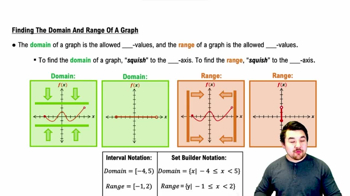
 5:10
5:10