Skip to main content
Precalculus
My Course
Learn
Exam Prep
AI Tutor
Study Guides
Flashcards
Explore
Try the app
My Course
Learn
Exam Prep
AI Tutor
Study Guides
Flashcards
Explore
Try the app
Back
Precalculus Test 2 Key Concepts
You can tap to flip the card.
Distance formula between two points
You can tap to flip the card.
👆
Distance formula between two points
The distance between points (x₁, y₁) and (x₂, y₂) is \(\sqrt{(x_2 - x_1)^2 + (y_2 - y_1)^2}\).
Track progress
Control buttons has been changed to "navigation" mode.
1/20
Recommended videos
02:16
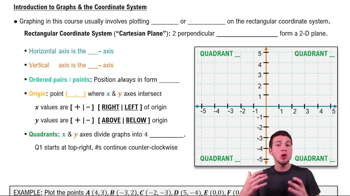
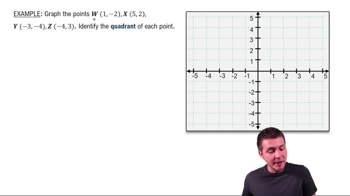
Graphs and Coordinates - Example
3552
views
318
rank
05:10
Graphs & the Rectangular Coordinate System
7510
views
265
rank
1
comments
Terms in this set (20)
Hide definitions
Distance formula between two points
The distance between points (x₁, y₁) and (x₂, y₂) is \(\sqrt{(x_2 - x_1)^2 + (y_2 - y_1)^2}\).
Midpoint formula between two points
The midpoint of segment with endpoints (x₁, y₁) and (x₂, y₂) is \(\left(\frac{x_1 + x_2}{2}, \frac{y_1 + y_2}{2}\right)\).
Finding the second endpoint given one endpoint and midpoint
Use midpoint formula: if midpoint M and endpoint A are known, then second endpoint B is \((2x_M - x_A, 2y_M - y_A)\).
Standard form equation of a circle
A circle with center (h, k) and radius r has equation \((x - h)^2 + (y - k)^2 = r^2\).
General form equation of a circle
The general form is \(x^2 + y^2 + Dx + Ey + F = 0\), where D, E, and F are constants.
How to graph a circle from its equation
Identify center (h, k) and radius r from standard form, then plot center and draw circle with radius r.
Determining if a relation is a function
A relation is a function if each input (x-value) has exactly one output (y-value).
Domain of a function
The set of all possible input values (x-values) for which the function is defined.
Range of a function
The set of all possible output values (y-values) of the function.
Evaluating a function at a given input
Substitute the input value into the function's formula and simplify to find the output.
Graphing a line from an equation
Rewrite the equation in slope-intercept form \(y = mx + b\), plot the y-intercept, then use slope to find another point.
Writing the equation of a line given slope and point
Use point-slope form: \(y - y_1 = m(x - x_1)\).
Evaluating a composition of functions
To find (f ∘ g)(x), first evaluate g(x), then substitute that result into f.
Transformations of graphs
Include translations (shifts), reflections, stretches, and compressions applied to the parent function.
Effect of adding a constant outside the function
Adding a constant k outside f(x) shifts the graph vertically by k units.
Effect of adding a constant inside the function argument
Adding a constant h inside f(x + h) shifts the graph horizontally by -h units.
Reflection over the x-axis
Multiply the function by -1: graph of y = -f(x) is the reflection of y = f(x) over the x-axis.
Reflection over the y-axis
Replace x by -x: graph of y = f(-x) is the reflection of y = f(x) over the y-axis.
Vertical stretch or compression
Multiply f(x) by a factor a: if |a| > 1, vertical stretch; if 0 < |a| < 1, vertical compression.
Horizontal stretch or compression
Replace x by bx: if |b| > 1, horizontal compression; if 0 < |b| < 1, horizontal stretch.
 BackBack
 02:16