Skip to main content
Precalculus
My Course
Learn
Exam Prep
AI Tutor
Study Guides
Flashcards
Explore
Try the app
My Course
Learn
Exam Prep
AI Tutor
Study Guides
Flashcards
Explore
Try the app
Back
Precalculus: Trigonometric Identities and Sum/Difference Formulas
You can tap to flip the card.
What is the Pythagorean identity involving sine and cosine?
You can tap to flip the card.
👆
What is the Pythagorean identity involving sine and cosine?
The identity is \(\sin^2\theta + \cos^2\theta = 1\).
Track progress
Control buttons has been changed to "navigation" mode.
1/21
Recommended videos
Guided course
6:36
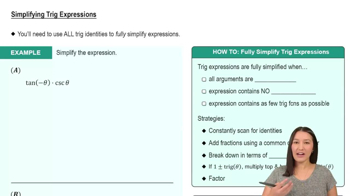
Simplifying Trig Expressions
1353
views
34
rank
Guided course
2:20
Example 1
2119
views
59
rank
Guided course
5:18
Example 4
1051
views
40
rank
1
comments
Terms in this set (21)
Hide definitions
What is the Pythagorean identity involving sine and cosine?
The identity is \(\sin^2\theta + \cos^2\theta = 1\).
State the identity for tangent in terms of sine and cosine.
Tangent
is defined as \(\tan\theta = \frac{\sin\theta}{\cos\theta}\).
What is the sum formula for sine: sin(a + b)?
\(\sin(a+b) = \sin a \cos b + \cos a \sin b\).
What is the difference formula for sine: sin(a - b)?
\(\sin(a-b) = \sin a \cos b - \cos a \sin b\).
What is the sum formula for cosine: cos(a + b)?
\(\cos(a+b) = \cos a \cos b - \sin a \sin b\).
What is the difference formula for cosine: cos(a - b)?
\(\cos(a-b) = \cos a \cos b + \sin a \sin b\).
State the sum formula for tangent: tan(a + b).
\(\tan(a+b) = \frac{\tan a + \tan b}{1 - \tan a \tan b}\).
State the difference formula for tangent: tan(a - b).
\(\tan(a-b) = \frac{\tan a - \tan b}{1 + \tan a \tan b}\).
What is the double-angle formula for sine: sin(2θ)?
\(\sin(2\theta) = 2 \sin\theta \cos\theta\).
What is the double-angle formula for cosine: cos(2θ)?
There are three forms: \(\cos(2\theta) = \cos^2\theta - \sin^2\theta\), \(= 2\cos^2\theta - 1\), and \(= 1 - 2\sin^2\theta\).
What is the double-angle formula for tangent: tan(2θ)?
\(\tan(2\theta) = \frac{2 \tan\theta}{1 - \tan^2\theta}\).
State the reciprocal identity for sine.
Cosecant
is the reciprocal of sine: \(\csc\theta = \frac{1}{\sin\theta}\).
State the reciprocal identity for cosine.
Secant
is the reciprocal of cosine: \(\sec\theta = \frac{1}{\cos\theta}\).
State the reciprocal identity for tangent.
Cotangent
is the reciprocal of tangent: \(\cot\theta = \frac{1}{\tan\theta} = \frac{\cos\theta}{\sin\theta}\).
What is the co-function identity for sine and cosine?
\(\sin(90^\circ - \theta) = \cos\theta\) and \(\cos(90^\circ - \theta) = \sin\theta\).
What is the co-function identity for tangent and cotangent?
\(\tan(90^\circ - \theta) = \cot\theta\) and \(\cot(90^\circ - \theta) = \tan\theta\).
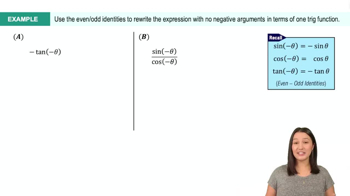
What is the identity for sine of a negative angle?
\(\sin(-\theta) = -\sin\theta\).
What is the identity for cosine of a negative angle?
\(\cos(-\theta) = \cos\theta\).
What is the identity for tangent of a negative angle?
\(\tan(-\theta) = -\tan\theta\).
What is the product-to-sum formula for sin a sin b?
\(\sin a \sin b = \frac{1}{2}[\cos(a-b) - \cos(a+b)]\).
What is the product-to-sum formula for cos a cos b?
\(\cos a \cos b = \frac{1}{2}[\cos(a-b) + \cos(a+b)]\).
 BackBack
 6:36