What factor can increase accurate responding in classical conditioning experiments?
Accurate responding in classical conditioning experiments can be increased by clearly pairing the neutral stimulus with the unconditioned stimulus, ensuring participants can reliably associate the two.
What is an example of higher-order conditioning in classical conditioning?
Higher-order conditioning occurs when a previously conditioned stimulus is used as a basis to condition a new neutral stimulus, so the new stimulus elicits the conditioned response even without the original unconditioned stimulus.
What conditioning technique have psychologists used to promote personal growth?
Psychologists have used classical conditioning techniques to promote personal growth, such as pairing positive experiences or stimuli with desired behaviors to encourage beneficial emotional responses.
In what type of conditioning does the likelihood of a behavior decrease because of its unpleasant consequences?
In classical conditioning, the likelihood of a behavior can decrease if it is paired with an unpleasant stimulus, leading to aversive conditioning.
What is the misinformation effect in psychology?
The misinformation effect refers to the phenomenon where a person's memory of an event can be altered by misleading information presented after the event, leading to inaccurate recall.
Reduced anxiety is one reported side effect of which psychological technique?
Reduced anxiety is one reported side effect of classical conditioning techniques, especially when used in therapeutic settings to help individuals overcome fears.
What are some examples of classical conditioning in everyday life?
Examples of classical conditioning in everyday life include developing a fear of dogs after being bitten (dog becomes a conditioned stimulus for fear), feeling hungry when hearing a lunch bell, or associating a particular song with a happy memory.
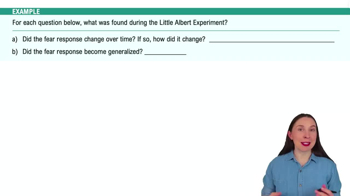
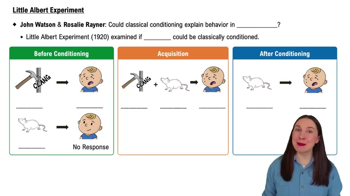
Who conducted the Little Albert experiment and in what year did it take place?
John Watson and Rosalie Rayner conducted the Little Albert experiment in 1920. It was designed to test classical conditioning in humans.
What phenomenon was demonstrated when Albert showed fear toward objects similar to the white rat?
This phenomenon is called stimulus generalization. It occurs when a conditioned response is triggered by stimuli that resemble the original conditioned stimulus.
Why would the Little Albert experiment not be approved by modern ethical standards?
Modern ethical standards require participant safety and oversight by an Institutional Review Board (IRB). The Little Albert experiment would not be approved today due to concerns about emotional harm and lack of informed consent.
 Back
Back
 04:56
04:56