How is Mary Ainsworth defined in the context of AP Psychology?
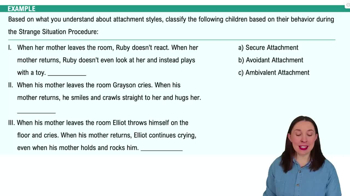
Mary Ainsworth is known for identifying attachment styles and developing the Strange Situation procedure.
Separation anxiety and stranger wariness are two kinds of what in infancy and toddlerhood?
Attachment behaviors.
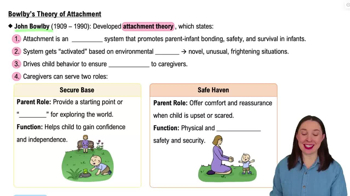
According to Bowlby, what is an infant's internal working model of attachment?
A cognitive schema about self, others, and relationships, shaped by early interactions with caregivers.
What is a child's typical activity during the oral stage according to developmental theory?
Sucking, feeding, and exploring the world through the mouth.
Shortly after birth, what do infants prefer?
Infants prefer familiar voices and faces, especially those of their caregivers.
Self-soothing is to passive as what is to active in the context of attachment behaviors?
Seeking proximity to the caregiver is to active.
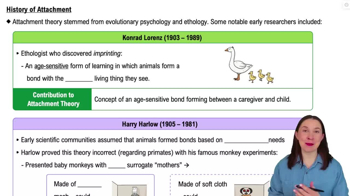
What is the main finding from Harry Harlow's monkey experiments regarding attachment?
Harlow found that baby monkeys preferred spending time with a soft, comforting surrogate mother over a wire one that provided food. This demonstrated that comfort and emotional security are crucial components of attachment.
How does the Strange Situation Procedure activate the attachment system in infants?
The Strange Situation Procedure places infants in a novel or unusual situation involving separations and reunions with their caregiver. This activates the attachment system by eliciting behaviors that reveal the child's attachment style.
What caregiving behavior is most commonly associated with the development of ambivalent (resistant) attachment in children?
Ambivalent attachment is most often linked to inconsistent caregiving, where parents unpredictably alternate between being responsive and unresponsive. This inconsistency leaves children unsure about whether their needs will be met.
Besides caregiving, what other factors can influence the development of attachment styles in children?
Child temperament and cultural context can also impact attachment style. Temperament refers to the child's personality traits, while cultural norms shape parenting behaviors and expectations.
In psychology, what is 'contact comfort' and why is it important in attachment theory?
Contact comfort refers to the physical and emotional comfort that infants receive from being in close physical contact with a caregiver. Harry Harlow's experiments with monkeys demonstrated that infants prefer comfort and security from a soft, cuddly surrogate mother over a wire mother that only provides food. This finding showed that comfort and emotional security are crucial for parent-child bonding, highlighting that attachment is based on more than just meeting biological needs.
 Back
Back
 03:13
03:13