What is the learned response to a conditioned stimulus in classical conditioning?
The learned response to a conditioned stimulus is called the conditioned response.
Which experiment is a classic example of classical conditioning?
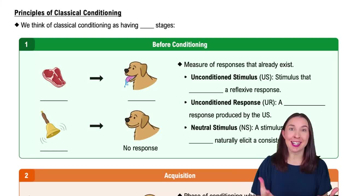
Ivan Pavlov's experiment with dogs, where a neutral stimulus (bell) was paired with an unconditioned stimulus (food) to elicit a conditioned response (salivation), is a classic example of classical conditioning.
Which two concepts are considered opposite processes within the classical conditioning model?
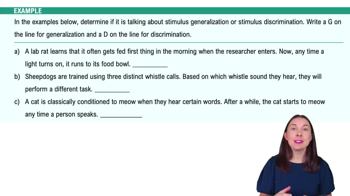
Stimulus generalization and stimulus discrimination are considered opposite processes within classical conditioning.
What is an example of a response acquired through classical conditioning?
Salivating in response to a bell after it has been paired with food is a response acquired through classical conditioning.
What is an unconditioned stimulus (US) in classical conditioning?
An unconditioned stimulus is a stimulus that naturally and automatically elicits a reflexive response without prior learning.
How does advertising use classical conditioning to help sell products?
Advertising often pairs a neutral stimulus (the product) with positive unconditioned stimuli (such as attractive imagery or pleasant music) so that the product becomes associated with positive feelings, eliciting a conditioned response.
What is an example of stimulus discrimination in classical conditioning?
Stimulus discrimination occurs when an organism responds only to the conditioned stimulus and not to similar stimuli; for example, a dog salivates only to the sound of a specific bell and not to other similar sounds.
What is a neutral stimulus in classical conditioning?
A neutral stimulus is a stimulus that does not naturally elicit any specific response before conditioning.
What is true about Ivan Pavlov?
Ivan Pavlov was a Russian physiologist credited with discovering classical conditioning while studying digestion in dogs.
Which principle underlies the effectiveness of systematic desensitization?
Systematic desensitization is effective because it uses classical conditioning to gradually associate a feared stimulus with relaxation instead of anxiety.
What did Robert Rescorla's research demonstrate about classical conditioning?
Robert Rescorla's research demonstrated that classical conditioning involves learning that the conditioned stimulus predicts the unconditioned stimulus, not just simple association.
What are examples of primary reinforcers in conditioning?
Primary reinforcers are stimuli that are naturally reinforcing, such as food, water, and warmth.
What is an unconditioned response in classical conditioning?
An unconditioned response is an unlearned, automatic reaction to an unconditioned stimulus.
What is an example of classical conditioning?
A dog salivating to the sound of a bell after the bell has been repeatedly paired with food is an example of classical conditioning.
How does a dog demonstrate stimulus discrimination in classical conditioning?
A dog demonstrates stimulus discrimination when it salivates only to the specific conditioned stimulus (such as a particular bell) and not to other similar sounds.
What is an example of classical conditioning in everyday life?
Feeling hungry when hearing a lunch bell after repeatedly eating lunch when the bell rings is an example of classical conditioning.
What is not an example of a primary reinforcer?
A token or money is not a primary reinforcer; it is a secondary reinforcer.
What was the primary conclusion John B. Watson made after working with Little Albert?
John B. Watson concluded that emotional responses such as fear can be conditioned in humans through classical conditioning.
What did the Little Albert studies demonstrate about classical conditioning?
The Little Albert studies demonstrated that it is possible to condition emotional responses, such as fear, in humans using classical conditioning.
What is an important difference between classical and operant conditioning?
Classical conditioning involves associating two stimuli to elicit a response, while operant conditioning involves learning through consequences that follow a behavior.
What is an example of stimulus discrimination in classical conditioning?
Stimulus discrimination is shown when an organism responds only to the conditioned stimulus and not to similar stimuli; for example, a dog salivates only to a specific bell tone.
What are examples of responses learned through classical conditioning?
Examples include salivating to a bell, feeling fear at the sight of a previously neutral object, or feeling hungry when hearing a specific sound.
What is true of unconditioned stimuli?
Unconditioned stimuli naturally and automatically elicit unconditioned responses without prior learning.
What is a similarity between classical conditioning and operant conditioning?
Both classical and operant conditioning are forms of associative learning.
What is an example of aversive conditioning?
Aversive conditioning occurs when a neutral stimulus is paired with an unpleasant unconditioned stimulus, such as pairing a sound with a mild shock to produce a fear response.
Which process is not one of the main processes of classical conditioning explored by Pavlov?
Reinforcement by consequences is not a process of classical conditioning; it is part of operant conditioning.
What scenario describes a primary reinforcer?
Receiving food when hungry is an example of a primary reinforcer.
What is true of acquisition in classical conditioning?
Acquisition is the initial phase in classical conditioning when the neutral stimulus is repeatedly paired with the unconditioned stimulus, leading to the learned association.
What is Ivan Pavlov most known for in psychology?
Ivan Pavlov is most known for discovering and developing the concept of classical conditioning.
In what scenario does sunblock serve as a conditioned stimulus?
Sunblock becomes a conditioned stimulus if it is repeatedly paired with a positive experience, such as relief from sunburn, leading to a learned response.
What has occurred when there is a decrease in the likelihood or rate of a target response in conditioning?
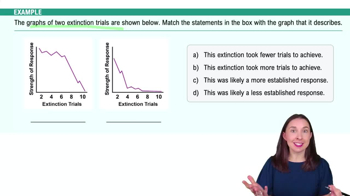
Extinction has occurred when the conditioned response decreases and eventually disappears after the conditioned stimulus is presented without the unconditioned stimulus.
What is the best example of a primary reinforcer?
Food is the best example of a primary reinforcer.
What is important to consider when planning a classical conditioning experiment?
It is important to ensure that the neutral stimulus precedes the unconditioned stimulus for effective conditioning.
How could John Watson have eliminated Little Albert's conditioned fear?
John Watson could have eliminated Little Albert's conditioned fear through extinction by repeatedly presenting the conditioned stimulus without the unconditioned stimulus.
What is true of primary reinforcers?
Primary reinforcers are naturally reinforcing and do not require learning, such as food or water.
Which idea is not one of Pavlov's major contributions to psychology?
The concept of reinforcement by consequences is not one of Pavlov's major contributions; it is associated with operant conditioning.
What was Ivan Pavlov researching when he discovered classical conditioning?
Ivan Pavlov was researching digestion in dogs when he discovered classical conditioning.
What did Robert Rescorla and Allan Wagner's experiments establish about classical conditioning?
Rescorla and Wagner's experiments established that classical conditioning involves learning that the conditioned stimulus predicts the unconditioned stimulus.
What is true about taste aversion learning?
Taste aversion learning can occur after just one pairing and is often resistant to extinction due to biological preparedness.
Who is most closely associated with classical conditioning?
Ivan Pavlov is most closely associated with classical conditioning.
 Back
Back
 06:45
06:45