Contemporary Psychology: Putting it All Together quiz #1 Flashcards

Contemporary Psychology: Putting it All Together quiz #1
Control buttons has been changed to "navigation" mode.
1/10
  • Why is it important for psychologists to consider multiple psychological perspectives rather than focusing on only one?
    Each psychological perspective offers unique insights into human behavior and mental processes. Because human psychology is highly complex, using multiple perspectives—such as social, cognitive, neuroscience, developmental, evolutionary, and cultural—provides a more holistic and complete understanding. No single perspective is inherently better or more accurate; instead, they complement each other and help explain behavior from different angles.
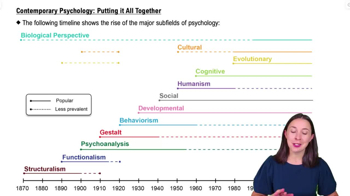
  • What do the solid and dotted lines on the psychology timeline represent?
    Solid lines indicate when a psychological field was prominent, while dotted lines show periods when the field was less prevalent. This helps visualize the rise and decline of different perspectives over time.
  • Why did the biological perspective in psychology become more prominent in the 1980s and 1990s?
    The biological perspective gained prominence as technological advances allowed for more research. Earlier limitations in technology had restricted its development.
  • Which modern subfield of psychology is rooted in humanistic theory but is considered distinct from it?
    Positive psychology is a modern subfield that has roots in humanistic theory but is considered distinct. It focuses on well-being and human strengths.
  • How are behaviorist principles applied outside of therapy in contemporary psychology?
    Behaviorist principles are used in areas like marketing, where understanding and influencing consumer behavior is important. Techniques from behaviorism help shape advertising strategies.
  • What impact did Wilhelm Wundt and William James have on contemporary psychology?
    Wilhelm Wundt's interest in culture and William James's focus on evolution influenced later developments in cultural and evolutionary psychology. Their work had a trickle-down effect on the field.
  • How do contemporary psychologists view the ambiguity between different psychological perspectives?
    Contemporary psychologists recognize that different perspectives may explain the same phenomenon in valid but distinct ways. They advise embracing this ambiguity as each lens offers valuable insights.
  • What is a common student reaction to the multiple valid explanations offered by different psychological perspectives?
    Students often feel frustrated by the lack of a single 'right' answer when multiple perspectives provide valid explanations. This ambiguity is normal and reflects the complexity of human psychology.
  • Which historical perspectives are considered less prominent today but still influence current psychological practices?
    Psychoanalysis, behaviorism, gestalt, and humanism are less prominent but their principles are still used in modern therapies and research. Techniques from these perspectives have been modified for contemporary use.
  • What advice is given to students regarding the value of different psychological perspectives?
    Students are encouraged to appreciate that no perspective is inherently better or more accurate than another. Each perspective examines human behavior through a unique lens, contributing to a holistic understanding.