Which type of developmental research design involves studying the same individuals on multiple occasions over time?
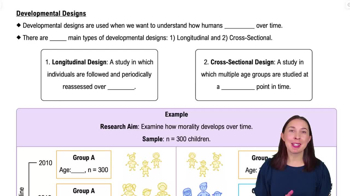
A longitudinal design involves studying the same individuals on multiple occasions over time.
What is another term used to describe a longitudinal research design in developmental psychology?
A repeated-measures design is another term used to describe a longitudinal research design.
What is the primary difference between pretest/posttest designs and within-groups (longitudinal) designs in developmental research?
The primary difference is that pretest/posttest designs typically compare groups before and after an intervention, while within-groups (longitudinal) designs track the same individuals over multiple time points to observe changes within those individuals.
What type of developmental research design compares people of different ages at the same point in time?
A cross-sectional research design compares people of different ages at the same point in time.
Which type of developmental research design includes two or more groups of individuals, often of different ages, studied at a single time point?
A cross-sectional research design includes two or more groups of individuals, often of different ages, studied at a single time point.
How does cross-sequential research combine the longitudinal and cross-sectional research methods in developmental psychology?
Cross-sequential research combines longitudinal and cross-sectional methods by following multiple age groups over time, allowing researchers to observe both individual development and age group differences.
What is attrition in the context of longitudinal developmental research designs?
Attrition refers to participants dropping out of a study over time. This can lead to statistical issues and a less representative sample by the end of the study.
Why can longitudinal designs provide stronger evidence for possible causal relationships than cross-sectional designs?
Longitudinal designs collect data at multiple time points, allowing researchers to establish temporal precedence. This means they can determine if one variable precedes another, which is important for inferring possible causality.
What is a key limitation of cross-sectional designs regarding the measurement of developmental change?
Cross-sectional designs cannot track individual development over time because they only collect data at a single time point. This prevents them from capturing unique growth patterns within individuals.
How do the strengths of longitudinal and cross-sectional designs complement each other in developmental research?
Longitudinal designs excel at capturing individual development and temporal precedence, while cross-sectional designs are faster, less expensive, and avoid attrition. The strengths of one design typically address the limitations of the other.
In the context of developmental psychology, what is the definition of a cohort?
A cohort refers to a group of individuals who share a common characteristic, typically age, and are studied together in developmental research designs to compare changes or differences across groups.
 Back
Back
 00:59
00:59