What is an action directly following a particular behavior called in operant conditioning?
A consequence.
Unlike classical conditioning, when does behavior typically occur in operant conditioning?
Behavior occurs voluntarily and is influenced by its consequences.
Which principles are best illustrated by operant conditioning?
The association between voluntary behaviors and their consequences, such as reinforcement and punishment.
Operant conditioning is better than classical conditioning at explaining which types of behaviors?
Voluntary behaviors that are influenced by consequences.
What does administering an aversive stimulus following an operant response represent?
Positive punishment.
When removal of a stimulus in response to a behavior increases the frequency of that behavior, what is this called?
Negative reinforcement.
Which term best describes an operant behavior?
A voluntary behavior that is influenced by its consequences.
In instrumental conditioning, what is punishment?
Punishment is a consequence that decreases the likelihood of a behavior.
What is negative punishment?
Negative punishment involves removing a pleasant stimulus to decrease the likelihood of a behavior.
How does differential reinforcement work?
Differential reinforcement works by reinforcing desired behaviors while withholding reinforcement for undesired behaviors.
What is one main difference between bribery and reinforcement?
Reinforcement is delivered contingent upon a specific behavior, while bribery may occur before the behavior.
How does differential reinforcement operate?
By providing reinforcement only for desired behaviors and not for undesired ones.
What is the definition of operant conditioning in AP Psychology?
Operant conditioning is a learning process in which behavior is shaped and maintained by its consequences, such as reinforcement and punishment.
What is the main idea of operant conditioning?
Behavior is influenced by the consequences that follow it, increasing or decreasing its likelihood.
Does continuous reinforcement occur when a response is reinforced only some of the time?
No, continuous reinforcement occurs when every response is reinforced; reinforcing only some responses is intermittent reinforcement.
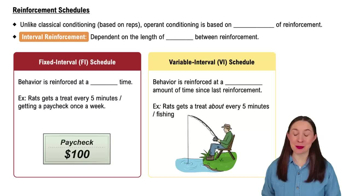
What are reinforcement schedules?
Reinforcement schedules are specific patterns that determine when a behavior will be reinforced, such as fixed or variable intervals and ratios.
How would you use operant conditioning to teach a dog a new behavior?
By reinforcing the desired behavior with rewards, such as treats, each time the dog performs the behavior.
In operant conditioning, how are complex behaviors learned?
Complex behaviors are learned through shaping, which involves reinforcing successive approximations of the target behavior.
Is lighting a fire on a cold night to get warm an example of positive reinforcement?
No, it is an example of negative reinforcement, as it removes the unpleasant stimulus of cold.
If reprimands are the only form of attention given, what can happen?
Reprimands may become reinforcing if they are the only attention received, increasing the undesired behavior.
What is a stimulus change that follows a behavior of interest called?
A consequence.
Is the key to success with extinction to combine it with punishment?
No, extinction is most effective when reinforcement is withheld, not necessarily when combined with punishment.
What is a reinforcer delivered contingent upon the first behavior called?
A response-contingent reinforcer.
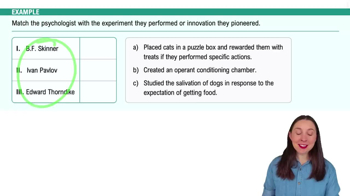
What is a Skinner box used to study?
A Skinner box is used to study operant conditioning by controlling the environment and consequences for animal behavior.
What does operant conditioning focus on?
Operant conditioning focuses on the association between voluntary behaviors and the stimuli that follow them.
How does extinction of behavior maintained by positive reinforcement work?
Extinction occurs when the positive reinforcement is no longer provided, leading to a decrease in the behavior.
Why might reinforcement attempts not work?
Reinforcement may not work if the reinforcer is not important or valued by the subject.
Does positive punishment occur when a pleasant stimulus is removed after a behavior?
No, positive punishment involves adding an unpleasant stimulus; removing a pleasant stimulus is negative punishment.
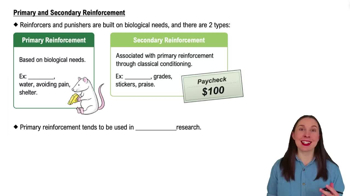
How do reinforcement types match their descriptions?
Positive reinforcement adds a pleasant stimulus; negative reinforcement removes an unpleasant stimulus; positive punishment adds an unpleasant stimulus; negative punishment removes a pleasant stimulus.
What does strengthening a response in operant conditioning mean?
It means the response is more likely to occur in the future due to reinforcement.
When a behavior leads to escape or avoidance of tasks, what reinforcement category is this?
Negative reinforcement.
What is a stimulus in the presence of which reinforcement is not available called?
An S-delta (discriminative stimulus for extinction).
What is the AP Psychology definition of operant conditioning?
Operant conditioning is a learning process in which behavior is shaped by its consequences, such as reinforcement and punishment.
What is the AP Psychology definition of positive reinforcement?
Positive reinforcement is the addition of a pleasant stimulus following a behavior to increase its likelihood.
What are examples of operant conditioning in everyday life?
Examples include receiving praise for good work, earning money for completing tasks, or losing privileges for misbehavior.
Why must replacement behavior strategies include reinforcement procedures?
To ensure that the new, desired behavior is strengthened and maintained over time.
What is an example of positive punishment?
Giving a child extra chores after they misbehave.
Which experiment involves the use of operant conditioning?
An experiment where animals learn to press a lever for food in a controlled environment, such as a Skinner box.
What is an example of positive reinforcement?
Giving a student a gold star for completing their homework.
How do negative reinforcement and positive punishment compare?
Negative reinforcement increases behavior by removing an unpleasant stimulus; positive punishment decreases behavior by adding an unpleasant stimulus.
 Back
Back
 01:26
01:26