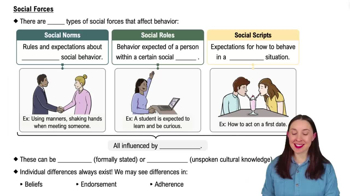
What are the three main types of social forces that influence behavior?
The three main types of social forces that influence behavior are social norms, social roles, and social scripts.
In the context of social relationships, what do individuals experience in addition to rewards?
In social relationships, individuals experience costs as well as rewards.
How can social forces be classified in terms of how they are communicated to individuals?
Social forces can be explicit, meaning formally stated, or implicit, meaning unspoken cultural knowledge. Both types influence behavior in society.
What is an example of an implicit social script mentioned in the video?
An implicit social script example is knowing how to act on a first date without being given step-by-step instructions. People often learn these behaviors by observing others and media.
How did Zimbardo attempt to make the prison environment realistic for his experiment?
Zimbardo created individual cells, costumes, and props in the basement of Stanford University. He also arranged for participants to be arrested by local police and processed at a police station.
What psychological effects did the prisoners in the Stanford Prison Experiment begin to show early in the study?
The prisoners began showing signs of distress, anxiety, and helplessness very early in the experiment. Their behavior became increasingly despondent and anxious.
What methodological concern arose from the way Zimbardo recruited participants for his experiment?
Zimbardo's recruitment through a prison study ad attracted participants higher in authoritarianism and aggression. This may have influenced the behaviors observed in the experiment.
Why is it difficult to determine if the guards' behavior in the Stanford Prison Experiment was genuine?
Zimbardo primed the guards with specific expectations for their conduct, which may have led them to act according to instructions rather than their true nature. Many guards later reported they were simply acting as expected.
What happened when other researchers tried to replicate the Stanford Prison Experiment without priming the guards?
Attempts to replicate the experiment without priming the guards did not result in the same immediate adoption of sadistic behaviors. This suggests the original findings may not be reliable.
How do individual differences affect the influence of social forces on behavior?
Individual differences mean that not everyone will endorse or adhere to social forces in the same way. Assumptions about behavior based solely on culture can be misleading.
What are social norms and how do they relate to everyday behavior?
Social norms are rules and expectations about general social behavior, guiding how people are expected to act in public or social settings. Examples include using manners, being polite, and shaking hands when meeting someone. These norms help shape everyday behavior and are influenced by culture.
 Back
Back

 02:10
02:10