Which of the following is not a region of the brain: the frontal lobe, the parietal lobe, the occipital lobe, or the femur?
The femur is not a region of the brain; it is a bone in the leg.
Which lobe of the brain receives input that enables you to feel sensations such as someone scratching your back?
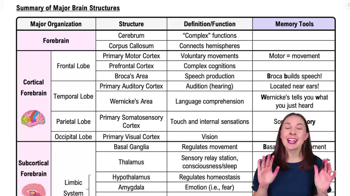
The parietal lobe receives somatosensory input, allowing you to feel sensations like someone scratching your back.
What is the name of the part of the brainstem that connects directly with the spinal cord?
The medulla is the part of the brainstem that connects directly with the spinal cord.
What term is used to refer to regions of the brain that have been injured?
Regions of the brain that have been injured are referred to as lesions.
Which part of the brainstem serves as a bridge between the forebrain and the hindbrain and is important for the sleep-wake cycle?
The pons serves as a bridge between the forebrain and the hindbrain and is important for the sleep-wake cycle.
Is the cerebellum one of the brain's four major lobes?
The cerebellum is not one of the brain's four major lobes; the four major lobes are the frontal, temporal, parietal, and occipital lobes.
What is the function of the corpus callosum in the brain?
The corpus callosum connects the two cerebral hemispheres. It allows communication between the left and right sides of the brain.
Which brain structure acts as a sensory relay station and is also important for consciousness and sleep?
The thalamus acts as a sensory relay station. It also plays a role in consciousness and sleep regulation.
What are the three major structures of the limbic system and their primary functions?
The hypothalamus regulates homeostasis, the amygdala is important for emotion (especially fear), and the hippocampus is crucial for memory formation. Together, they control emotion, memory, and survival-related behaviors.
How does the reticular formation contribute to the sleep-wake cycle?
The reticular formation helps regulate arousal and attention, contributing to the wake side of the sleep-wake cycle. It also assists the pons and medulla in autonomic functions like breathing.
Which brain regions are primarily responsible for learning, memory, and personality?
The prefrontal cortex in the frontal lobe is responsible for complex cognition and personality, while the hippocampus in the limbic system is essential for memory formation and learning.
 Back
Back
 07:55
07:55