Skip to main content
Introduction to Psychology
My Course
Learn
Exam Prep
AI Tutor
Study Guides
Flashcards
Explore
Try the app
My Course
Learn
Exam Prep
AI Tutor
Study Guides
Flashcards
Explore
Try the app
Back
Visual Stimuli quiz #2
You can tap to flip the card.
What is change blindness in psychology?
You can tap to flip the card.
👆
What is change blindness in psychology?
Change blindness is the failure to notice significant changes in a visual scene.
Track progress
Control buttons has been changed to "navigation" mode.
1/33
Related flashcards
Related practice
Recommended videos
Visual Stimuli quiz #1
Visual Stimuli
39 Terms
Visual Stimuli definitions
Visual Stimuli
12 Terms
Visual Stimuli
4. Sensation and Perception
7 problems
Topic
Nicole
Visual Anatomy
4. Sensation and Perception
7 problems
Topic
Nicole
4. Sensation and Perception
3 topics
9 problems
Chapter
Nicole
Guided course
01:30
Visual Stimuli Example 1
995
views
24
rank
1
comments
Guided course
03:43
Visual Stimuli
1388
views
28
rank
Terms in this set (33)
Hide definitions
What is change blindness in psychology?
Change blindness is the failure to notice significant changes in a visual scene.
What is the retina in psychology?
The retina is the light-sensitive layer at the back of the eye that contains photoreceptors.
What is the Snellen letter chart commonly used to test for?
The Snellen letter chart is commonly used to test visual acuity.
Which type of stimulus is most likely to be semantically coded?
Stimuli that have meaning or can be associated with concepts are most likely to be semantically coded.
What is an example of a monocular cue for depth perception?
Relative size is an example of a monocular cue.
Under which condition would the release of neurotransmitter by photoreceptors be greatest?
The release of neurotransmitter by photoreceptors is greatest in darkness.
What is an example of the phi phenomenon in psychology?
The phi phenomenon is the illusion of movement created by rapidly presenting a series of still images.
What is the definition of blindsight in psychology?
Blindsight is the ability to respond to visual stimuli without conscious visual perception.
What is the area you can see around you called?
This is called the field of vision.
What is the definition of relative clarity in psychology?
Relative clarity is a depth cue where objects that appear sharper are perceived as closer than blurry objects.
What is the definition of the retina in psychology?
The retina is the layer of tissue at the back of the eye that detects light and sends signals to the brain.
Which field of vision allows you to read and see details?
The central field of vision allows you to read and see details.
Which lobe of the brain is most associated with processing visual information?
The occipital lobe is most associated with processing visual information.
What is the definition of the visual cliff in psychology?
The visual cliff is an experimental setup used to study depth perception in infants and animals.
What is the definition of perceptual constancy in psychology?
Perceptual constancy is perceiving objects as unchanging despite changes in sensory input.
What is the definition of figure-ground in psychology?
Figure-ground is the ability to distinguish an object (figure) from its background (ground).
What is the definition of retinal disparity in psychology?
Retinal disparity is the difference in images between the two eyes, which helps with depth perception.
What is the primary sensory skill involved in verbal communication?
The primary sensory skill involved in verbal communication is audition (hearing).
What is the definition of texture gradient in psychology?
Texture gradient is a monocular cue where objects with finer, more detailed textures are perceived as closer.
What are visual distractions?
Visual distractions are stimuli that divert attention away from the primary visual task.
What are monocular cues?
Monocular cues are depth cues that can be perceived with one eye alone.
What are stimuli in the context of sensation and perception?
Stimuli are types of energy or information that activate sensory receptors.
What happens to the eye when exposed to bright light?
Exposure to bright light causes the pupil to constrict.
How can using images increase one’s understanding of information?
Using images can enhance understanding by providing visual representations that make information easier to process and remember.
Where does the majority of visual information you get while driving come from?
The majority of visual information while driving comes from the central and peripheral fields of vision.
Is the average field of vision 125 degrees?
The average human field of vision is approximately 180 degrees horizontally.
What is perception distance?
Perception distance refers to the distance at which an object can be detected and recognized by the senses.
Do both retinal disparity and convergence increase as an object gets closer?
Yes, both retinal disparity and convergence increase as an object gets closer to the observer.
What is true of parallel processing in the visual system?
Parallel processing refers to the brain's ability to process multiple aspects of a visual scene simultaneously.
What is a binocular cue for the perception of distance?
Retinal disparity is a binocular cue for perceiving distance.
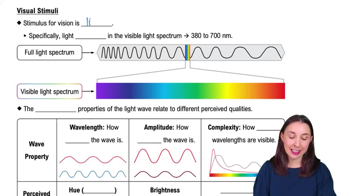
Brightness or dullness refer to which attribute of color?
Brightness or dullness refer to the amplitude of the light wave, which affects the perceived brightness of color.
What effect would injury or trauma to the right visual cortex have on vision?
Injury to the right visual cortex would result in loss of vision in the left visual field of both eyes.
Which lobe of the cerebrum is involved in the visual memory of objects?
The occipital lobe is primarily involved in the visual memory of objects.
 BackBack
 01:30
01:30