Skip to main content
Introduction to Psychology
My Course
Learn
Exam Prep
AI Tutor
Study Guides
Flashcards
Explore
Try the app
My Course
Learn
Exam Prep
AI Tutor
Study Guides
Flashcards
Explore
Try the app
Back
Brain Structure and Function in Psychology
You can tap to flip the card.
Forebrain
You can tap to flip the card.
👆
Forebrain
The most evolutionarily complex brain part, housing the cerebrum responsible for logic, rational thought, and working memory.
Track progress
Control buttons has been changed to "navigation" mode.
1/20
Recommended videos
Guided course
00:46
Organization of the Brain Example 1
909
views
11
rank
Guided course
02:26
Organization of the Brain
1019
views
16
rank
Terms in this set (20)
Hide definitions
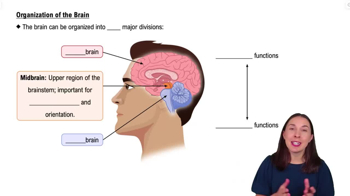
Forebrain
The most evolutionarily complex brain part, housing the cerebrum responsible for logic, rational thought, and working memory.
Cerebrum
The largest brain portion divided into two hemispheres connected by the corpus callosum, responsible for advanced cognitive functions.
Corpus callosum
A bundle of nerve fibers connecting the two cerebral hemispheres, facilitating communication between them.
Frontal lobe
Contains the primary motor cortex for voluntary movement and the prefrontal cortex for executive control and emotional integration.
Broca's area
Located near the motor cortex, it is crucial for speech production.
Temporal lobe
Located near the ears, includes the primary auditory cortex for hearing and Wernicke's area for language comprehension.
Parietal lobe
Contains the primary somatosensory cortex, responsible for processing touch and proprioception.
Occipital lobe
Located at the back of the brain, dedicated to vision and housing the primary visual cortex.
Basal ganglia
Subcortical structures that regulate movement, acting as a bridge between the primary motor cortex and spinal cord.
Thalamus
A sensory relay station that routes signals and contributes to consciousness and sleep.
Limbic system
Includes the hypothalamus, amygdala, and hippocampus; essential for homeostasis, emotional regulation, and memory formation.
Hypothalamus
Manages survival functions such as hunger, thirst, and body temperature regulation.
Amygdala
Linked to emotions, especially fear and emotional processing.
Hippocampus
Crucial for developing new memories and memory consolidation.
Midbrain
Located centrally, involved in movement and orientation.
Hindbrain
Responsible for basic life functions, including structures like the pons and medulla.
Pons
Regulates the sleep-wake cycle and connects different brain regions.
Medulla
Controls autonomic functions such as breathing and reflexes.
Reticular formation
Extends through the pons and medulla, regulating autonomic functions and contributing to arousal and attention.
Cerebellum
Known as the 'tiny brain,' essential for coordination, balance, and precise motor control.
 BackBack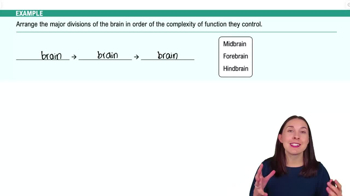
 00:46
00:46