 Back
chapter 2
 03:03

Terms in this set (22)
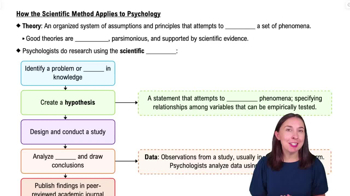
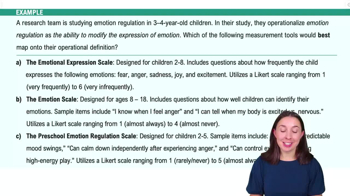
Theory is a broad explanation of phenomena, a hypothesis is a testable prediction derived from a theory, and an operational definition specifies how variables are measured or manipulated in a study.
Skepticism involves questioning claims and seeking evidence rather than mere disbelief, ensuring scientific conclusions are reliable and valid.
Falsifiability means a hypothesis can be proven wrong, which is critical for scientific research to be testable and refutable.
Openness allows sharing methods and data, while replication tests if results are consistent, both ensuring scientific reliability.
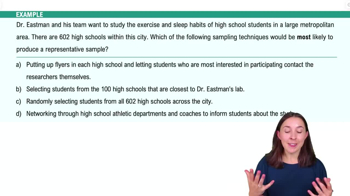
Participants can be selected by random sampling or convenience sampling; selection methods affect how results generalize to populations.
Case studies provide detailed information about individuals but may lack generalizability and be subject to researcher bias.
Observational methods allow study of behavior in natural settings but can be time-consuming and may lack control over variables.
Norms provide comparison standards, reliability ensures consistent results, and validity confirms the test measures what it intends.
Surveys can collect data from many people quickly but may suffer from biased responses and inaccurate self-reporting.
Cross-cultural research must address language differences, cultural norms, and biases to ensure valid comparisons.
A correlation coefficient indicates the direction (positive or negative) and strength (size) of the relationship between two variables.
The independent variable is manipulated by the researcher; the dependent variable is the outcome measured.
Random assignment creates equivalent groups, reducing bias and allowing causal conclusions between experimental and control groups.
The experimental group receives the treatment; the control group does not, serving as a baseline for comparison.
Experiments allow causal inference but may have artificial settings and ethical constraints limiting generalizability.
Descriptive statistics summarize data to compare group performance using measures like mean, median, and standard deviation.
Statistical significance indicates a low probability results are due to chance but does not measure practical importance.
Statistics can be misrepresented by selective reporting, misleading graphs, or ignoring effect size.
Cross-sectional studies compare different groups at one time; longitudinal studies follow the same group over time.
Effect size measures the magnitude of results; meta-analysis combines studies; Bayesian statistics update probabilities with new data.
Informed consent ensures participants understand the study; debriefing explains the study purpose and addresses concerns afterward.
Animal research requires minimizing harm, justifying use, and following ethical guidelines to protect animal welfare.