 Back
BackFoundations and Perspectives in Psychology
 01:11
01:11
Terms in this set (20)
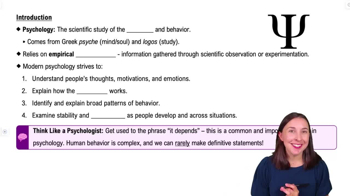
Psychology is the scientific study of the mind and behavior, relying on empirical observation and experimentation.
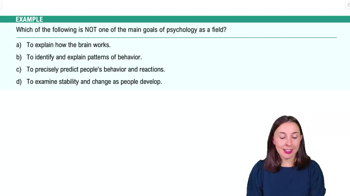
Understand thoughts, motivations, emotions; explain brain function; identify behavior patterns; examine stability and change across development and situations.
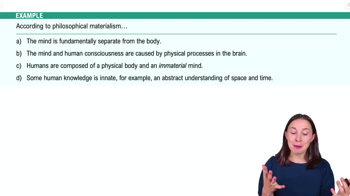
Materialism: Mind and consciousness arise from physical brain processes. Dualism: Mind and body are separate entities.
Empiricism: Knowledge comes from experience (blank slate). Nativism: Some knowledge is innate (e.g., causality, space).
Considered the father of modern psychology; founded structuralism, studying the basic elements of conscious experience via introspection.
Approach analyzing the structure of the mind by breaking down conscious experience into basic elements.
Father of functionalism; focused on the function of mental processes and their adaptive significance, influenced by Darwin's natural selection.
Emphasizes unconscious motives and early childhood experiences influencing behavior; developed psychoanalytic theory and therapy.
Focuses on perception as organized wholes, not just the sum of parts; 'The whole is greater than the sum of its parts.'
Focuses on observable behavior and stimulus-response relationships; emphasizes learning through conditioning.
Learning process where a neutral stimulus becomes associated with a meaningful stimulus, eliciting a conditioned response (Pavlov's dogs).
Learning where behavior is shaped by rewards and punishments (Skinner).
Studies how psychological phenomena change across the lifespan, focusing on when, why, and how changes occur.
Examines how social environments influence individual and group behavior, including attitudes, identity, and stereotypes.
Emphasizes inherent human goodness, free will, and the potential for personal growth and self-actualization (Maslow, Rogers).
Focuses on mental processes like perception, memory, language, and problem solving; inspired by the analogy of the mind as an information processor.
Studies how behavior and mental processes have evolved through natural selection to solve adaptive problems.
Explores how culture shapes human behavior and mental processes, emphasizing the importance of cultural context.
Studies the relationship between the brain/nervous system and behavior or mental processes, focusing on biological mechanisms.
Using various perspectives (biological, cognitive, social, etc.) provides a holistic understanding of complex human behavior and mental processes.