 Back
BackIntroduction to Psychology - Chapter 1 Concepts
 01:11
01:11
Terms in this set (20)
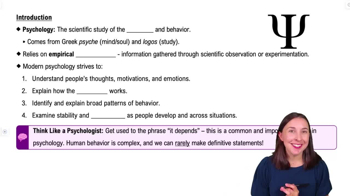
Psychology is the scientific study of behavior and mental processes.
The study of behavior (observable actions) and mental processes (internal experiences like thoughts and feelings).
Psychology relies on observation and experimentation rather than intuition or opinion.
A theory is a broad explanation based on evidence; a hypothesis is a testable prediction derived from a theory.
A systematic process involving observation, hypothesis formation, experimentation, and conclusion.
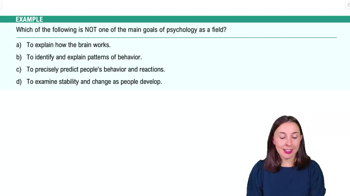
To describe, explain, predict, and control behavior and mental processes.
An early school of psychology focused on breaking down mental processes into basic components using introspection.
A school of psychology that studied how mental processes help individuals adapt to their environment.
Wilhelm Wundt is often called the father of psychology for establishing the first psychology lab.
A perspective focusing on observable behavior and the role of environmental stimuli in shaping it.
The study of mental processes such as perception, memory, problem-solving, and decision-making.
An approach that considers biological, psychological, and social factors in understanding behavior and mental health.
Basic psychology seeks to increase knowledge; applied psychology uses that knowledge to solve real-world problems.
A research method that examines the relationship between two variables without implying causation.
A controlled study where the researcher manipulates one variable to observe its effect on another.
When participants experience changes due to their expectations rather than the treatment itself.
Participants must be fully informed about a study and voluntarily agree to participate.
To protect participants from harm and ensure research is conducted responsibly.
The brain's ability to change and adapt as a result of experience.
Nature refers to genetic inheritance; nurture refers to environmental influences on behavior.