 Back
BackIntroduction to Psychology - Key Concepts and Research Methods
 01:11
01:11
Terms in this set (26)
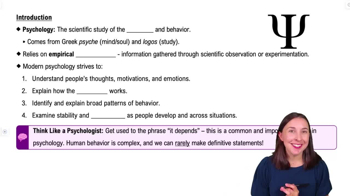
Psychology is the scientific study of behaviour and mental processes.
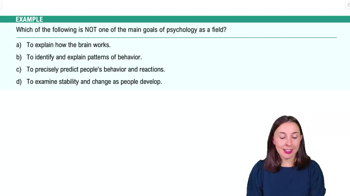
1. Description - describe behaviour or mental processes
2. Explanation - determine cause-effect relationships
3. Prediction - specify conditions when behaviour occurs
4. Influence - apply principles to change behaviour or outcomes
Basic research seeks new knowledge and understanding (goals 1-3). Applied research aims to solve practical problems and improve quality of life (goal 4).
Observing and recording behaviour in its natural setting without influencing or controlling it.
Observation conducted in a controlled laboratory setting, often using equipment to measure responses.
In-depth study of one or a few subjects using observation, interviews, or tests, useful for rare conditions or experiences.
Using interviews or questionnaires to gather information about attitudes, beliefs, or behaviours from a representative sample.
Two variables vary in the same direction; as one increases, the other also increases, or both decrease together.
Two variables vary in opposite directions; as one increases, the other decreases.
No. Correlation shows a relationship but does not prove one variable causes the other.
A research method that can identify cause-effect relationships by manipulating an independent variable and measuring a dependent variable.
Independent variable (IV): manipulated cause.
Dependent variable (DV): measured effect.
Randomly assigning participants to groups to prevent selection bias and ensure groups are comparable at the start.
Improvement due to expectations rather than treatment; controlled by including a control group receiving a placebo.
Researcher’s expectations influencing participants or results; prevented by double-blind studies where both are unaware of group assignments.
Reliable: consistent results.
Valid: measures what it intends to measure.
Reducing mental experiences to basic elements using introspection.
How mental processes function and help organisms adapt to their environment.
Perception is more than the sum of its parts; we perceive whole patterns and objects.
Observable, measurable behaviour shaped by learning and environment, ignoring mental processes.
Emphasizes the unconscious mind and how unconscious motives influence behaviour.
Human uniqueness, free choice, growth, and psychological health.
Study of mental processes like memory, problem solving, reasoning, and language.
Biological processes and heredity to understand behaviour.
How behaviours evolved to aid survival and reproduction.
Social and cultural influences on behaviour and interpretation of others' behaviour.