 Back
BackSensation and Perception in Psychology
 01:30
01:30
Terms in this set (28)
Sensation is the activation of receptors in the various sense organs.
Sensory receptors are specialized neurons stimulated by different kinds of energy, not neurotransmitters.
Transduction is the process of turning outside stimuli into neural activity.
The absolute threshold is the smallest amount of energy needed for a person to consciously detect a stimulus 50% of the time.
The difference threshold is the smallest difference between two stimuli detectable 50% of the time.
Subliminal stimuli are stimuli below the level of conscious awareness but strong enough to activate sensory receptors.
Habituation is the brain's tendency to stop attending to constant information; sensory adaptation is sensory receptors becoming less responsive to unchanging stimuli.
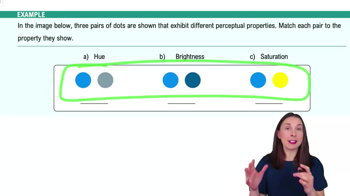
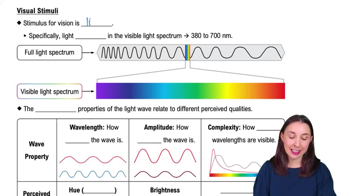
Brightness is determined by the amplitude of the light wave; higher waves mean brighter light.
Color (hue) is determined by the wavelength of light; longer wavelengths appear red, shorter appear blue.
Saturation is the purity of a color; mixing with black or gray reduces saturation.
Main parts: cornea, pupil, iris, lens, retina, and optic nerve.
Rods detect noncolor sensitivity in low light; cones detect color and sharpness of vision.
Nearsightedness occurs when the focal point falls short of the retina; farsightedness when it falls behind the retina.
The trichromatic theory proposes three types of cones sensitive to red, blue, and green colors.
The opponent-process theory suggests four primary colors arranged in pairs: red-green and blue-yellow.
Pitch is the psychological experience of sound frequency; higher frequencies produce higher pitches.
Place theory states different pitches stimulate hair cells at different locations on the organ of Corti.
Frequency theory relates pitch to the speed of vibrations in the basilar membrane.
Gate-control theory proposes pain signals pass through a 'gate' in the spinal cord that can block or allow pain messages.
Kinesthetic sense is the sense of body part location in relation to the ground and each other, detected by proprioceptors.
Binocular cues use both eyes, including convergence and binocular disparity, to perceive depth.
Monocular cues are depth cues from one eye, such as linear perspective, relative size, overlap, and texture gradient.
Perceptual set is the tendency to perceive things based on previous experiences or expectations.
Top-down processing uses preexisting knowledge to organize features into a whole perception.
The cocktail party effect is the ability to focus on a specific stimulus while filtering out others.
The Müller-Lyer illusion is a line length illusion caused by inward or outward turning corners, making equal lines appear different.
The moon illusion is when the moon appears larger on the horizon than in the sky, explained by the apparent distance hypothesis.
Parapsychology is the scientific study of ESP, ghosts, and related phenomena, though ESP is not decisively proven.