Statistics
My Course
Learn
Exam Prep
AI Tutor
Study Guides
Textbook Solutions
Flashcards
Explore
My Course
Learn
Exam Prep
AI Tutor
Study Guides
Textbook Solutions
Flashcards
Explore
Back
Chi Square Distribution definitions
You can tap to flip the card.
Define:
Chi Square Distribution
You can tap to flip the card.
👆
Chi Square Distribution
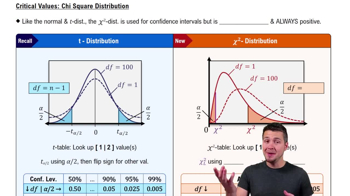
A right-skewed, asymmetric probability model used for analyzing variance, always yielding positive values starting at zero.
Track progress
Control buttons has been changed to "navigation" mode.
1/15
Related flashcards
Related practice
Recommended videos
Chi Square Distribution quiz #1
Chi Square Distribution
10 Terms
8. Sampling Distributions & Confidence Intervals: Proportion
1 topic
3 problems
Chapter
Ernest
Guided course
05:39
Critical Values: Chi Square Distribution
Patrick
211
views
3
rank
1
comments
Guided course
03:55
Critical Values: Chi Square Distribution Example 1
Patrick
122
views
2
rank
Guided course
05:18
Critical Values: Chi Square Distribution Example 2
Patrick
106
views
3
rank
Terms in this set (15)
Hide definitions
Chi Square Distribution
A right-skewed, asymmetric probability model used for analyzing variance, always yielding positive values starting at zero.
Variance
A measure of spread in a dataset, calculated as the square of the standard deviation, essential for confidence intervals.
Critical Value
A threshold from a statistical table that marks the boundary for a specified area under a distribution curve.
Confidence Interval
A range constructed from sample data that likely contains the true population parameter, based on a chosen confidence level.
Degrees of Freedom
A parameter, typically n minus one, indicating the number of independent values in a statistical calculation.
Alpha
The probability of error or the area in the tails of a distribution, calculated as one minus the confidence level.
Chi Square Table
A reference chart listing values for the chi square distribution, organized by area and degrees of freedom.
Right Tail
The portion of a distribution curve extending toward higher values, used for finding certain critical values.
Left Tail
The portion of a distribution curve extending toward lower values, relevant for locating specific critical values.
Chi Square Right
A critical value found using the area to the right, typically alpha divided by two, in the chi square distribution.
Chi Square Left
A critical value determined by the area to the right, calculated as one minus alpha divided by two.
Confidence Level
The proportion of times a confidence interval is expected to contain the true parameter, often expressed as a percentage.
Population Variance
The true measure of spread for an entire population, estimated using sample data and chi square methods.
Standard Deviation
A statistic representing the average distance of data points from the mean, whose square gives variance.
Asymmetry
A property of a distribution where the shape is not mirrored, causing different methods for finding critical values.