Pearson+ LogoPearson+ Logo

Confidence Intervals for Population Variance quiz #1 Flashcards

Back
Confidence Intervals for Population Variance quiz #1
Control buttons has been changed to "navigation" mode.
1/10
  • Can variance ever be negative in statistics?

    No, variance cannot be negative. Variance is defined as the average of the squared deviations from the mean, and since squares of real numbers are always non-negative, variance is always zero or positive.
  • What point estimate is used when constructing a confidence interval for population variance?

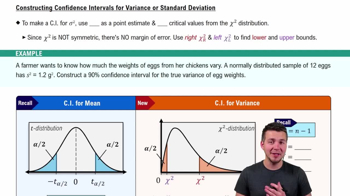
    The sample variance is used as the point estimate. It represents our best guess for the population variance.
  • Why is the chi-square distribution used instead of the normal or t-distribution for variance confidence intervals?

    The chi-square distribution is used because variance is a squared quantity and its sampling distribution is not symmetric. This makes the chi-square distribution appropriate for constructing confidence intervals for variance.
  • How do you determine the degrees of freedom when building a confidence interval for variance?

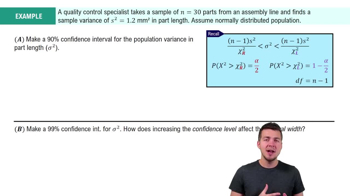
    Degrees of freedom are calculated as n minus 1, where n is the sample size. This value is used to look up critical values in the chi-square table.
  • What are the two critical values needed from the chi-square distribution to construct a confidence interval for variance?

    You need the right critical value (χr²) and the left critical value (χl²). These are found using the areas α/2 and 1-α/2, respectively.
  • How do you find the values of α and α/2 when given a confidence level for a variance interval?

    α is found by subtracting the confidence level from 1, and α/2 is half of α. For example, with a 90% confidence level, α is 0.1 and α/2 is 0.05.
  • What is the formula for the lower bound of a confidence interval for population variance using the chi-square distribution?

    The lower bound is calculated as (n-1) times the sample variance divided by the right chi-square critical value. This formula directly uses the sample size, sample variance, and critical value.
  • How do you convert a confidence interval for variance into one for standard deviation?

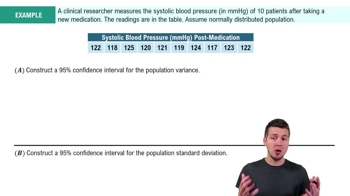
    Take the square root of both the lower and upper bounds of the variance interval. This gives the confidence interval for the population standard deviation.
  • Why is it important to verify that the sample comes from a normally distributed population when constructing these intervals?

    The method assumes normality of the population for the chi-square distribution to be valid. If the population is not normal, the confidence interval may not be accurate.
  • What happens to the confidence interval bounds if you mistakenly square the sample variance during calculations?

    Squaring the sample variance would result in incorrect bounds for the interval. This error would make the interval much larger than it should be and misrepresent the true variance.