Skip to main content
Introductory Statistics
My Course
Learn
Exam Prep
AI Tutor
Study Guides
Textbook Solutions
Flashcards
Explore
Try the app
My Course
Learn
Exam Prep
AI Tutor
Study Guides
Textbook Solutions
Flashcards
Explore
Try the app
Back
Counting definitions
You can tap to flip the card.
Permutation
You can tap to flip the card.
👆
Permutation
Ordered arrangement of distinct objects, where each item occurs only once and order is important.
Track progress
Control buttons has been changed to "navigation" mode.
1/15
Related flashcards
Related practice
Recommended videos
Counting quiz
Counting
15 Terms
Counting
4. Probability
6 problems
Topic
Ernest
Fundamental Counting Principle
4. Probability
6 problems
Topic
Ernest
4. Probability - Part 1 of 3
3 topics
9 problems
Chapter
Ernest
4. Probability - Part 2 of 3
4 topics
12 problems
Chapter
Ernest
4. Probability - Part 3 of 3
2 topics
6 problems
Chapter
Ally
Guided course
07:11
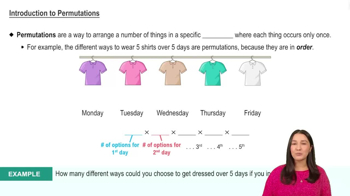
Introduction to Permutations
3706
views
89
rank
1
comments
Guided course
06:37
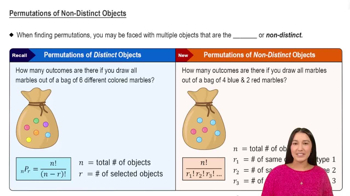
Permutations of Non-Distinct Objects
2670
views
58
rank
Guided course
03:59
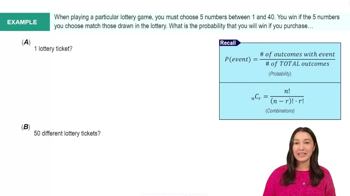
Counting Example 1
509
views
20
rank
Terms in this set (15)
Hide definitions
Permutation
Ordered arrangement of distinct objects, where each item occurs only once and order is important.
Combination
Unordered selection of objects, where the order does not affect the outcome and each group is unique.
Factorial
Product of all positive integers up to a given number, used to calculate arrangements and selections.
Fundamental Counting Principle
Method for finding total outcomes by multiplying the number of choices for each event.
Distinct Objects
Items that are different from each other, so each arrangement is unique.
Non-distinct Objects
Items that are identical, requiring adjustment in counting to avoid duplicate arrangements.
Permutation Formula
Equation using n factorial divided by (n minus r) factorial to count ordered arrangements.
Combination Formula
Equation using n factorial divided by (n minus r) factorial times r factorial to count unordered groups.
Notation
Symbols like P(n, r) or C(n, r) used to represent permutations and combinations in problems.
Outcome
Possible result of an arrangement or selection, influenced by whether order matters.
Word Bank
Set of available options for selection, often used in fill-in-the-blank problems.
Team Formation
Grouping of individuals from a larger set, where order may or may not matter.
Arrangement
Specific ordering of objects, relevant in permutation problems.
Selection
Choosing items from a set, relevant in combination problems.
Canceling Factorials
Simplifying calculations by rewriting numerators and denominators to eliminate common factorial terms.
 BackBack

 07:11
07:11