Grammar 101: insider tips and tricks to instantly improve your writing (part 2)

Hannah Lawrence
Hannah Lawrence
A professional man sits at a desk, writing notes with a laptop open in front of him.
Reading time: 5 minutes

As a proofreader and editor, I'm often asked to explain the rules of grammar. I answered three of the most common questions in the first post of this series, and now it's time to look at another frequent query: how to use apostrophes. Where do they go? When are they needed? And when should they be left out entirely?

Apostrophes might be small but they can cause big confusion because they are used both to indicate posession and to contract words. But the good news is that there are clear, simple patterns to follow, which we'll explore, along with exceptions to watch out for. Whether you’re writing a report or just a text message, these tips will help you use apostrophes correctly and confidently.

Apostrophes with ease: posession

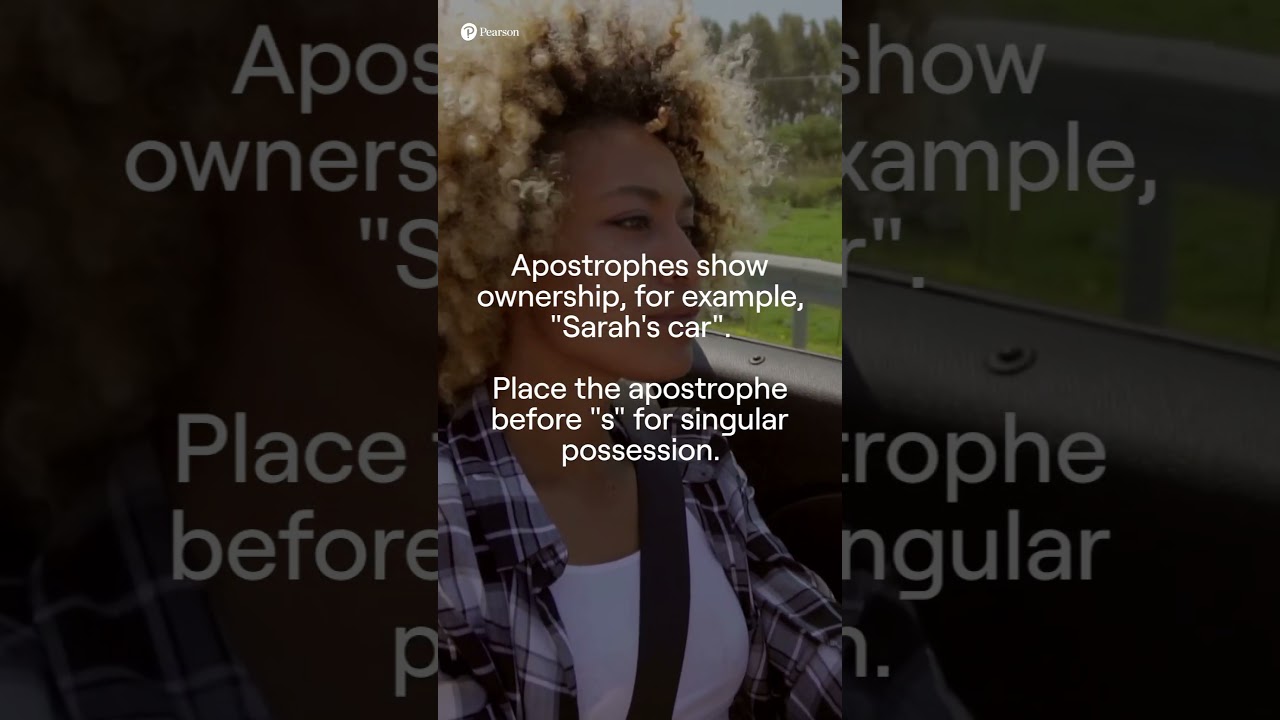
Apostrophes show possession: they tell us something belongs to someone or something. When we want to show possession for regular plurals (when a word needs an "s" to make it plural), the apostrophe goes at the end and no further "s" is added: 

  • The teachers' association
  • The campaigners' letter
  • The dogs' dinner

Whereas, when we want to show posession for either a single noun or an irregular plural (for example, children, geese), we add an "apostrophe s":

  • Sarah's car
  • Pearson's assessment tools
  • The children's presents
  • The geese's pond

Single names that end in an “s” get an “apostrophe s” but plural names get only an apostrophe:

  • Mrs Jones’s car
  • James's cat
  • Whole Foods’ offices
  • Starbucks' nearest store

There's one exception that's important to note: "its" and "it's". The posessive form "its" does not have an apostrophe: "it's" always means "it is". 

  • The cat ate its food

Apostrophes with ease: contractions

Contracted words are the combined and shortened forms of two words, which are commonly used in everyday writing and speech to sound more natural and conversational. They're made by omitting certain letters and replacing them with an apostrophe: for example, in "don't", it replaces the missing “o” from not. 

When you miss one or more letters, use an apostrophe:

  • "would not" becomes "wouldn’t"
  • "cannot" becomes "can’t"
  • "we are" becomes "we're"
  • and, as before, "it is" becomes "it's"

When not to use apostrophes

A common mistake is using apostrophes when making words plural or when refering to decades and numbers. For example:

  • The 1980s had the best music (not "The 1980's")
  • Many people retire from working in their 70s (not "their 70's")
  • I bought some apples at the store (not "apple's")
Using apostrophes: simple tips to improve your writing skills
Play
Privacy and cookies

By watching, you agree Pearson can share your viewership data for marketing and analytics for one year, revocable by deleting your cookies.

Test your knowledge

Now you know the basic rules of apostrophes, it's time to check your knowledge.

Which sentence is correct?:

  1. The childrens break time has finished
  2. The childrens' break time has finished
  3. The children's break time has finished

It's sentence 3. We want to show posession – break time belongs to the children – and "children" is plural so it gets an "apostrophe s".
Now try these sentences and see if you can figure out which one is right:

  1. When you're walking my dog, its important to remember it's collar.
  2. When you're walking my dog, it's important to remember its collar.
  3. When youre walking my dog, it's important to remember it's collar.

The correct answer is 2. "You're" is a contraction of "you are", "it is important" so we use "it's" and we show that the collar belongs to the dog by using "its". Finally: 

  1. Luis' daughter won't go to sleep. 
  2. Luis's daughter wont go to sleep. 
  3. Luis's daughter won't go to sleep. 

Here, the right answer is 3. "Luis" is a single name, so gets an "apostrophe s", and "will not" is shortened to "won't". 

Hopefully you now feel more confident in using apostrophes in your writing. Look out for the next post in this series, where we’ll explore more common grammar mistakes and how to avoid them.

More blogs from Pearson

  • People looking at a laptop discussing what they see
    Preparing your learners for university study abroad
    By Charlotte Guest
    Reading time: 5 minutes

    Studying abroad offers an exciting opportunity for students to explore new cultures, enhance their language skills and pursue further education. However, preparing for university abroad can be stressful and overwhelming, particularly for those leaving home for the first time.

    Educators are crucial in ensuring students feel ready, confident and equipped for international study. They support learners through academic guidance and emotional encouragement, helping build the skills necessary for success abroad.

    Why preparing students for study abroad matters

    Many learners focus mainly on getting accepted into a university. However, success abroad requires much more than good grades. Students must also adapt to a new education system, manage independent living and communicate in a different cultural environment.

    Without preparation, students may struggle with:

    • Culture shock
    • Homesickness
    • Academic pressure
    • Budgeting and financial management
    • Language barriers
    • Time management

    Providing support before students leave can improve confidence and help learners settle into university life more quickly.

  • Students walking together outside talking
    So you want to study in the USA? Here’s what to expect
    By Abi Fordham
    Reading time: 2 minutes

    When I talk to students planning to study in the USA, I always notice a mix of excitement and nerves. Before giving any advice, I begin by sharing a small personal truth.

    I didn’t study in the USA myself. I spent my university years in Leeds, England, running between lectures in the rain, squeezing into crowded cafés, feeling like my whole world lived inside that one brilliant, chaotic city. And I loved it.

    However, since I've worked in international education, it's broadened my perspective. Listening to students discuss the opportunities they’re pursuing in the US, including internships, campus experiences – and seeing the confidence they develop – has made me wonder if I might have chosen differently if I could go back in time.

    So now, when a student has questions about studying in the USA, I answer them based on everything I’ve learned from being closely involved in their journey. Let’s get into it.

    “Is studying in the USA actually worth it?”

    Absolutely, not just academically, but personally.  You get access to:

    • World-leading industries
    • Diverse, ambitious communities
    • New perspectives you can’t find at home
    • A degree that's recognized globally

    It’s one of the fastest ways to grow into the most confident version of yourself.

    “Will I fit in?”

    Yes. US campuses are remarkably diverse and host many international students. You’ll quickly find people who share your background, interests and ambitions. Simply join a club, attend a welcome event or try one new activity. That’s all it takes to get started.

    “The application process seems overwhelming.”

    It looks overwhelming until you break it down into manageable tasks:

    1. Shortlist universities
    2. Understand their timelines
    3. Organize your documents
    4. Choose an English test that actually supports your plans

    Which brings us to asking…

    “Which English test should I take?”

    If you want global options, then choose PTE Academic, which gives access to worldwide opportunities.

    If you’re set on the USA, then choose PTE Express. It's quick, online, flexible and specifically designed for studying in the US. It helps your application process run more smoothly and ensures you’re using a test that meets American university standards.

    “What is life in the USA actually like?”

    Think big campuses, huge energy, endless clubs and opportunities everywhere. But also think:

    • Independence
    • Cultural discovery
    • New friendships
    • Internships that shape your future

    Most students say they grow more in their first year abroad than in all their years of school before it.

    My perspective

    Studying in the USA is about more than just earning a degree. It can change how you see yourself. While my own path was different, I love helping students experience it and seeing where it takes them.

  • Two people learning on a bridge with a high rise building behind them
    Five fun outdoor activities to practice a new language
    By Charlotte Guest
    Reading time: 3 minutes

    Learning a new language does not have to happen only at home or in a classroom. In fact, sometimes we spend too much time sitting at our computers or staying inside. Taking a break and going outside can help your mind feel fresh and more open to learning. A change of environment can improve focus and make learning feel more enjoyable.

    Going outside can also make language practice more fun, natural and memorable. When you use a language in real-life situations, you often remember words better and feel more confident speaking.

    Here are five simple and enjoyable outdoor activities to help you practice your new language.

    1. Try a role-play adventure walk

    Turn a simple walk into a creative language challenge. Imagine you are a tourist, a guide or even a storyteller exploring a new place. As you walk, speak aloud in your target language as if you were describing the place to someone else.

    What you can do:

    • Pretend to give a tour: “On the left, we see a beautiful park.”
    • Create a short story about what is happening around you
    • Ask and answer your own questions

    Why it helps: This method encourages you to speak more and use your imagination. It can help you feel more comfortable forming sentences and speaking for longer periods.

    Tip: Record yourself on your phone and listen later to notice mistakes and progress.