
Four ways to keep kindergarten ESL students focused all day

Heath Pulliam
A teacher sat in a classroom with a child, sharing crayons with eachother and smiling
Reading time: 5 minutes

Heath Pulliam is an independent education writer with a focus on the language learning space. He’s taught English in South Korea and various subjects in the United States to a variety of ages. He’s also a language learning enthusiast and studies Spanish in his free time.

Those who have taught children anywhere between the ages of 4 and 8 know that one of the biggest challenges of getting through to them is keeping your presentation style interesting. As someone who taught ESL in South Korea to kindergarteners, there are a few factors that make keeping students engaged a challenge. In countries where students learn English, students often have a heavy courseload and high expectations. As a first-year teacher, I learned a lot about what worked and what didn’t through trial and error. These are four methods that I consistently used to keep my students interested and engaged all day.

Students are quick to lose focus at such a young age. You’re not speaking their mother tongue and some parts of an ESL curriculum are less than exciting. With young students, you can’t lecture your way through the material all day. Kindergarteners have a small window of focus and it must be capitalized on. The following methods are ones that worked for me and can be modified to cover any topic you’ll run into in an ESL curriculum.

Activities to engage pre-primary ESL students all day
Play
Privacy and cookies

By watching, you agree Pearson can share your viewership data for marketing and analytics for one year, revocable by deleting your cookies.

1. The wheel of names

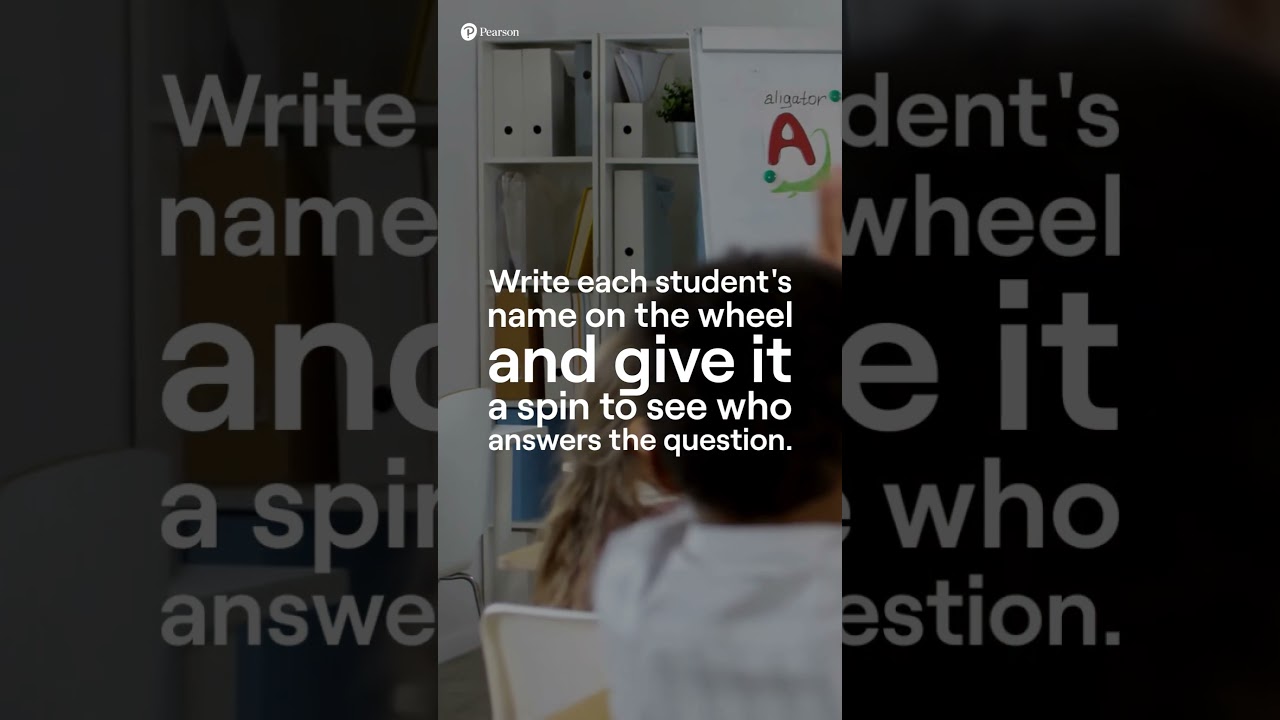
Don't let the simplicity of this tool fool you. The Wheel of Names, which is exactly what it sounds like, is a very simple tool that you can put the names of your students on to randomly (or not) select a student. The Wheel of Names crushes hand-raising and it’s a constant struggle to get everyone raising their hands. (We can’t let the quiet ones just slip through the cracks!)

The beauty of the Wheel of Names is the guaranteed excitement on every spin. They’re kindergarteners. The nature of randomizing who’s going to answer the question, come up to the board, or go first in a game is so exciting to them. Use it however you want. The suspense has kids excited to see who will be chosen and has them cheering on whichever classmate gets chosen.

I used this tool mostly during review sessions to choose students to answer questions. It can also be used for creating small groups, making sure everyone gets a chance to speak during activities and seeing who’s going to get to do the next fun thing in the classroom. You’re teaching kindy, have fun with it.

https://spinthewheel.io/

2. Team-based review game

We never came up with a good name for this game, but we used it a lot. Every Friday, during our chapter review, this was undoubtedly the best compromise between fun and effectiveness for reviewing material. It also fosters speaking, one of the most important parts of learning a language.

Here’s how it works. The class is separated into two teams. (For a little extra fun, use the wheel of names or a cup of popsicle sticks with students’ names on them to select the teams.) The teacher has a set of review questions or vocabulary words. On each turn, one person from each team has a chance to answer the question. You can do hand-raising or a randomization method to pick who answers.

If the student representative from the team gets it right, they earn a point. If they get it wrong, the opposing team gets a chance to answer for a point. Alternating between each team, the first to a certain number of points wins. A simple game, but at this age many students are just getting used to team-based activities.

This game is so effective because it makes use of children’s natural competitive spirit. When one student is up, the rest of their team cheers them on. Learning material is important, but a big part of teaching young students is teaching them social skills, too. This game gets everyone excited and gets the material to stick. It also teaches them the importance of teamwork and how to win and lose gracefully. (Not everyone can win every time).

3. Creating super sentences

At the end of the year, the students in my class ended up being the best writers in their respective age groups. I think this activity, making ‘Super Sentences” a few times a week was a big contributor to that. Inspired by a textbook we had, here’s how this activity works.

We’d create sentences with this formula:

Who or what – The owl

Did what – hunted for mice

Where – in the forest

When – at night

The owl hunted for mice in the forest at night.

Before students got to work on their own, We’d fill out a little table on the board as a class that looked something like this – but changed every time.

Who or what?

(noun)

Did what? (verb)

Where?

(prepositional phrase)

When?

(prepositional phrase)

The dog

The raccoon

Joey

Mr. Heath

Chloe

The thief

Ran

Slept

Attacked _______

Found _________

Learned to ________

sneaked

On top of __________

Under __________

Through the ________

Next to the  ________

Inside of the _______

Behind the ________

At sunset

At 4:00 PM

In the middle of the day

In March

In the evening

After this, students can get to work making their own sentences and drawing what is happening below. After a few times, many students began to make up their own nouns, verbs and prepositions that were not listed on the board. And when everyone gets comfortable writing sentences, you can add a ‘Why?’ section at the end.

This activity is one of my favorites because it helps bring out children’s natural creativity. In an ESL curriculum, there’s a lot of material that’s less than exciting, so any way to give the kids a little freedom can be a game-changer. It’s also great for vocabulary, grammar and writing practice.

To finish off the activity, have each student read their sentence and have the class vote on their favorite for a prize!

4. Vocabulary bingo

Something to know about teaching ESL in non-English-speaking countries is that often, no time is allowed to be spent not learning. This is definitely the case in South Korea. Even after lunch and towards the end of the day, students are rarely allowed to do anything if it isn’t enriching. Because of this, playing games that are fun and learning-effective is a must.

Now, I’m certainly not the first one to play Bingo. This version however, is slightly modified to be as enriching as possible. We played this version often at the end of the day, because focus runs low around that time.

Essentially, this is just vocabulary bingo with a little bit of charades mixed in. For this activity, make a basic bingo board with some of your current vocabulary words or target language. There are plenty of sites that make this easy.

What makes this version different is that on each turn, rather than telling everyone the word, describe it to the class and try to get them to guess what the word is. So, if the word was ‘teamwork’, you might say something like “This is what it’s called when everyone works together to help their team win.” You can even have a student helper that helps facilitate the game by giving the descriptions.

After the word is guessed, reiterate it to the class and proceed with Bingo as usual.

Conclusion

Part of being an effective teacher, especially with the younger ages, is harnessing kids’ natural excitement, energy and innate curiosity to their own benefit. Instead of suppressing it, it’s essential to adapt your teaching style to work for your students.

Teaching ESL to young children has its own set of challenges. They can hardly sit still for an hour of lecture, let alone a whole day. Make use of, or draw inspiration from these methods and see how they can work for you.

Teaching young learners? Read our post 'Effective classroom management routines for very young learners'.

More blogs from Pearson

  • Children in a classroom with a teacher while they play with a toyhouse
    The importance of teaching values to young learners
    By Katharine Scott
    Reading time: 3 minutes

    Why teaching values matters in early education

    The years children spend in school are about far more than academic success. Alongside literacy, numeracy and subject knowledge, children develop the social and emotional skills needed to thrive in the world around them.

    From sharing ideas to resolving disagreements, these everyday interactions shape how children understand fairness, respect and responsibility. These are more than just learned skills – they are rooted in deeper values that guide behavior over time.

    Without clear guidance, children often learn behaviors simply by observing others. While this can be positive, it can also reinforce negative habits. That’s why schools play a critical role in explicitly teaching values, not just expecting them.

    Social skills vs. Social values

    Although closely related, social skills and values are not the same:

    • Social skills are behaviors (such as taking turns, listening, cooperating)
    • Social values are the principles behind those behaviors (such as fairness, respect, empathy)

    When children understand why something matters—not just what to do—they are more likely to apply those behaviors consistently.

    Core values every child should learn

    Defining values can be complex, but most education systems emphasize a shared set of foundational principles:

    • Respect for others and appreciation of diversity
    • Collaboration and community awareness
    • Environmental responsibility
    • Self-worth and confidence

    Even at a young age, children demonstrate a natural sense of fairness and honesty. With the right support, these instincts can be developed into strong moral foundations.

    Moving beyond “School Rules”

    Too often, values are reduced to simple instructions like:

    • “Don’t be late”
    • “Wait your turn”
    • “Be kind”

    While important, these rules can feel arbitrary if not explained. Without context, children may follow them only when supervised – or break them when they can.

    To truly teach values, educators need to:

    • Explain the reasoning behind rules
    • Encourage discussion and reflection
    • Connect actions to real-world impact

    This transforms rules into meaningful learning experiences.

    Effective school strategies for teaching values

    The most successful approaches to values education involve the entire school community – teachers, students, parents and staff.

    1. Environmental awareness programs

    Schools can foster responsibility through hands-on initiatives such as:

    • Recycling systems
    • School gardens
    • Renewable energy projects
    • Second-hand bookshops

    These activities help children understand their role in protecting the planet.

    2. Anti-bullying initiatives

    Strong anti-bullying programs go beyond policies and focus on prevention through:

    • Empathy-building exercises
    • Peer accountability activities
    • Confidence and self-esteem development

    Helping children recognize and respond to bullying is key to creating a safe environment.

    3. Anti-racism and inclusion programs

    Promoting inclusivity requires a proactive, school-wide approach:

    • Teaching diverse histories and cultures
    • Inviting guest speakers from different communities
    • Challenging stereotypes through discussion
    • Encouraging empathy for marginalized groups

    These efforts help children develop respect for diversity from an early age.

    The role of consistency

    Children learn as much from what adults do as from what they say. For values education to be effective:

    • Teachers must model positive behavior
    • School policies should reflect stated values
    • Parents should be involved where possible

    Consistency across all environments reinforces learning and builds trust.

    Putting values into practice

    Teaching values to young learners is not an “extra” part of education – it is foundational. When children understand respect, empathy and responsibility, they are better equipped to succeed academically, socially and emotionally.

    By embedding values into everyday learning and school culture, educators can help shape thoughtful, responsible individuals who contribute positively to society.

  • A woman and man working together on laptop in library
    AI in Language Education: What educators should use (and what to avoid)
    By Charlotte Guest
    Reading time: 5 minutes

    AI is changing language classrooms fast, but not every tool adds value. The best teachers use AI as a partner, supporting planning, feedback and differentiation, while keeping key moments of teaching human.

    Here’s what works, what to avoid, and how to use AI responsibly in ESL classrooms.

    How AI is transforming language teaching

    AI is transforming how teachers work, but it doesn't replace them.

    At its best, AI enhances three core areas:

    • Planning efficiency: Generate lesson outlines, activities and scaffolding in minutes
    • Differentiation at scale: Adapt materials for mixed-level classrooms instantly
    • Feedback loops: Provide faster, more frequent feedback on writing and practice tasks

    But the key shift is pedagogical. AI aligns naturally with:

    • Learner-centered methods: Students engage more actively with adaptive content
    • Teaching like a coach: Teachers guide, refine and personalize rather than deliver everything directly
    • Modern teaching methodology: Blended, flexible and responsive instruction

    When used effectively, AI allows teachers to concentrate on the most important aspects of language learning: interaction, communication and human connection.

  • A woman smiling working on a laptop
    Studying in the USA? A fast at-home English test is now an option
    By Abi Fordham
    Reading time: 2 minutes

    If you’re a student planning to study in the USA, life probably feels a bit like having too many tabs open at once. University sites. Visa info. Messages from friends already abroad. And a growing list of things that all feel important.

    Somewhere in the middle of that is your English test.

    A test people trust for good reason

    For years, students have chosen PTE because it’s built to be trusted, backed by real expertise, research and quality. That’s why it’s become a familiar name for students planning to study abroad, and why institutions trust it too. That foundation hasn’t changed. What has changed is how students live, learn, and prepare today.

    Same roots, for different routes

    PTE Express originates from the same principles. Same values. Same attention. It’s simply tailored for a different kind of test taker at a specific point in their journey. If you’re aiming to study in the USA and need a quick, at-home English test, PTE Express is made to fit into your life rather than forcing you to reshape everything around a test date. And let’s address test anxiety because it’s a real concern.

    Many students worry about English tests. Not because they don’t know English, but because test situations can make things feel harder than they should be. Speaking to an examiner face‑to‑face can feel intimidating. Worrying about being misunderstood because of your accent is a real concern. Travelling to a test centre adds pressure before you even start. Sitting in an unfamiliar room can make nerves worse.

    That’s not a lack of ability. That’s just being human. While PTE Academic already addresses lots of these worries, we have gone a step further with PTE Express.

    Why at‑home testing can feel different

    One of the quiet benefits of an at‑home test is how much calmer it can feel. You’re in a familiar space. You control your environment. There’s no examiner in front of you, just you and the screen. For many students, that makes it easier to focus and show their real English, without the extra stress that comes from unfamiliar settings or face‑to‑face pressure. PTE Express was designed with this in mind: calm, considered, and supportive, while still being secure and trusted by institutions.

    When the USA is the plan

    If you already know the USA is your destination, things can start to feel more time‑sensitive. Deadlines get closer. Decisions feel heavier. You’re no longer exploring, you’re preparing your next move. PTE Express fits naturally here. It’s a fast, at‑home option for US study, built on the foundations of Pearson that students already trust, and delivered in a way that works for when life is busy and timelines are tight.

    A choice that actually reduces pressure

    The good news is, you don’t have to overthink this. If you want to keep your options open across different countries, there’s a trusted path in PTE Academic that supports that. If you’re focused on studying in the USA and want something fast, familiar and at home, there’s now an option designed for exactly that. No trade‑offs. No feeling like you’re cutting corners. Just choices that match different moments.

    Focus on what really matters

    Studying in the USA is a big step. It’s about independence, growth and starting something new. Your English test should feel like something that supports you quietly in the background, not something that adds more stress to an already intense moment. With PTE Express now live in most countries, including India, students heading to the USA have a calm, trusted at‑home option, built on foundations that have been relied on for years. And sometimes, feeling calm and confident is exactly what helps you do your best.