Which of these cells engulf bacteria and break them down: lymphocytes, phagocytes, T-cells, or B-cells?
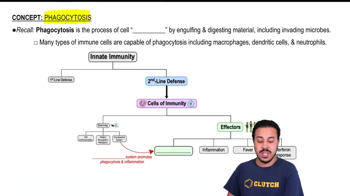
Phagocytes, which include macrophages, dendritic cells, and neutrophils, are responsible for engulfing and breaking down bacteria.
What is true about the process of phagocytosis?
Phagocytosis involves immune cells engulfing and digesting invading microbes through a series of steps including chemotaxis, recognition, and exocytosis.
How do macrophages ingest bacteria and/or viruses?
Macrophages ingest bacteria and viruses by engulfing them through the process of phagocytosis, forming a phagosome that fuses with lysosomes to digest the microbes.
Which cells are phagocytic?
Phagocytic cells include macrophages, dendritic cells, and neutrophils.
Which stage is not part of phagocytosis: chemotaxis, recognition, replication, or exocytosis?
Replication is not a stage of phagocytosis.
Which statement best describes phagocytosis?
Phagocytosis is the process by which immune cells engulf and digest invading microbes through a series of steps.
How do phagocytes recognize pathogens?
Phagocytes recognize pathogens through direct binding via mannose binding lectins or indirectly via opsonins.
What is the role of chemotaxis in phagocytosis?
Chemotaxis involves the movement of phagocytes towards chemical signals at the site of infection.
What happens during the engulfment stage of phagocytosis?
During engulfment, phagocytes surround and ingest the microbe, forming a phagosome.
What occurs during the exocytosis stage of phagocytosis?
During exocytosis, the phagolysosome fuses with the cell membrane to release degraded microbial material.
 Back
Back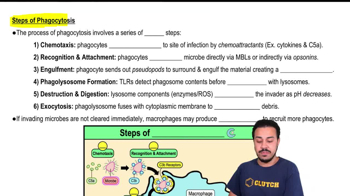
 8:57
8:57