Back

Fluid Flow & Continuity Equation quiz

Control buttons has been changed to "navigation" mode.
1/9
  • Which flow tube length had the greatest flow rate?

    The flow rate is determined by the cross-sectional area and the fluid speed. According to the continuity equation, if the cross-sectional area decreases, the fluid speed must increase to maintain the same flow rate. Therefore, the tube with the smallest cross-sectional area will have the greatest flow rate if the fluid speed is increased accordingly.
  • Which two flow tubes have similar cross-sectional areas?

    Two flow tubes have similar cross-sectional areas if their volume flow rates and fluid speeds are similar, as the flow rate is given by Q = A * v. If the flow rates and speeds are equal, the cross-sectional areas must also be equal.
  • What is the difference between fluid speed and volume flow rate?

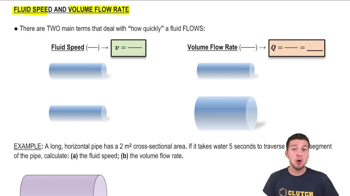
    Fluid speed is the velocity of a fluid particle measured in meters per second, while volume flow rate is the volume of fluid flowing per unit time, measured in cubic meters per second.
  • How can the volume flow rate be expressed in terms of cross-sectional area and fluid speed?

    The volume flow rate, Q, can be expressed as Q = A * v, where A is the cross-sectional area and v is the fluid speed.
  • What does the continuity equation state about fluid flow in a pipe with changing cross-sectional areas?

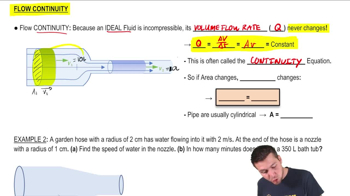
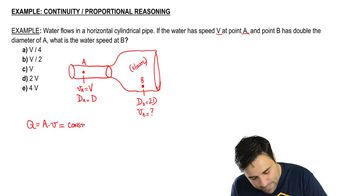
    The continuity equation states that the product of cross-sectional area and fluid speed must remain constant, ensuring that the volume flow rate is conserved.
  • How does reducing the cross-sectional area of a pipe affect fluid speed according to the continuity equation?

    Reducing the cross-sectional area of a pipe increases the fluid speed to maintain a constant volume flow rate.
  • What happens to the fluid speed when the cross-sectional area of a pipe increases?

    When the cross-sectional area of a pipe increases, the fluid speed decreases to maintain the same volume flow rate.
  • How do you calculate the fluid speed in a pipe if you know the distance traveled and time taken?

    Fluid speed is calculated as the distance traveled divided by the time taken, v = Δx/Δt.
  • What is the relationship between the radius of a pipe and its cross-sectional area?

    The cross-sectional area of a cylindrical pipe is proportional to the square of its radius, A = πr².