Skip to main content
Analytical Chemistry
My Course
Learn
Exam Prep
AI Tutor
Study Guides
Flashcards
Explore
Try the app
My Course
Learn
Exam Prep
AI Tutor
Study Guides
Flashcards
Explore
Try the app
Back
Diprotic Acids and Bases definitions
You can tap to flip the card.
Diprotic Acid
You can tap to flip the card.
👆
Diprotic Acid
A molecule capable of donating two protons in two sequential steps, each with its own equilibrium constant.
Track progress
Control buttons has been changed to "navigation" mode.
1/15
Related flashcards
Related practice
Recommended videos
Diprotic Acids and Bases quiz
Diprotic Acids and Bases
15 Terms
Diprotic Acids and Bases
9. Polyprotic Acid-Base Equilibria
5 problems
Topic
Polyprotic Acids and Bases
9. Polyprotic Acid-Base Equilibria
5 problems
Topic
9. Polyprotic Acid-Base Equilibria - Part 1 of 2
4 topics
12 problems
Chapter
9. Polyprotic Acid-Base Equilibria - Part 2 of 2
2 topics
6 problems
Chapter
Guided course
13:13
Diprotic Acids and Bases Calculations 1
571
views
3
rank
Guided course
04:22
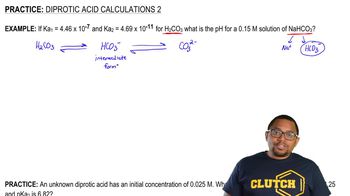
Diprotic Acids and Bases Calculations 2
410
views
4
rank
2
comments
Guided course
02:41
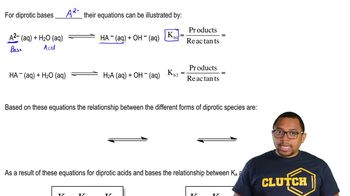
Diprotic Bases
501
views
1
rank
Terms in this set (15)
Hide definitions
Diprotic Acid
A molecule capable of donating two protons in two sequential steps, each with its own equilibrium constant.
Diprotic Base
A species able to accept two protons, with each acceptance described by a separate equilibrium constant.
Ka1
The equilibrium constant for the removal of the first proton from a diprotic acid, always larger than the second.
Ka2
The equilibrium constant for the removal of the second proton from a diprotic acid, always smaller than the first.
Kb1
The equilibrium constant for the acceptance of the first proton by a diprotic base.
Kb2
The equilibrium constant for the acceptance of the second proton by a diprotic base.
Kw
The ion-product constant for water, equal to 1.0 x 10^-14 at 25°C, linking acid and base equilibria.
Amphoteric Species
An intermediate form that can act as either an acid or a base, depending on the reaction conditions.
Conjugate Base
The form of an acid after it donates a proton, capable of further proton loss or gain.
Equilibrium Constant
A value expressing the ratio of products to reactants at equilibrium for a reversible chemical reaction.
Fully Protonated Form
The state of a diprotic acid containing both acidic hydrogens, behaving like a monoprotic acid.
Intermediate Form
A species with one removable hydrogen, able to act as either an acid or a base in diprotic systems.
Hydrogen Sulfate
A common amphoteric species that can donate or accept a proton, often used to illustrate acidic amphoterism.
Hydrogen Carbonate
A basic amphoteric species, also known as bicarbonate, capable of both donating and accepting protons.
Polyprotic Species
A molecule with more than one ionizable hydrogen, including diprotic and triprotic acids and bases.
 BackBack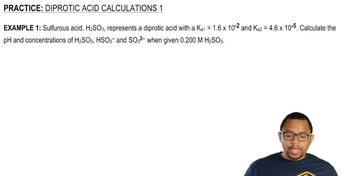
 13:13
13:13