Skip to main content
Analytical Chemistry
My Course
Learn
Exam Prep
AI Tutor
Study Guides
Flashcards
Explore
Try the app
My Course
Learn
Exam Prep
AI Tutor
Study Guides
Flashcards
Explore
Try the app
Back
Safety & Labels quiz
You can tap to flip the card.
What organization defines chemical safety guidelines in analytical labs?
You can tap to flip the card.
👆
What organization defines chemical safety guidelines in analytical labs?
OSHA (Occupational Safety and Health Administration) defines chemical safety guidelines in analytical labs.
Track progress
Control buttons has been changed to "navigation" mode.
1/15
Related flashcards
Related practice
Recommended videos
Safety & Labels definitions
Safety & Labels
15 Terms
Safety & Labels
2. Tools of the Trade
5 problems
Topic
Buoyancy
2. Tools of the Trade
5 problems
Topic
2. Tools of the Trade - Part 1 of 2
4 topics
11 problems
Chapter
2. Tools of the Trade - Part 2 of 2
1 topic
3 problems
Chapter
Guided course
05:13
Safety & Labels
395
views
3
rank
Terms in this set (15)
Hide definitions
What organization defines chemical safety guidelines in analytical labs?
OSHA (Occupational Safety and Health Administration) defines chemical safety guidelines in analytical labs.
What color represents health hazards on chemical labels?
Health hazards are represented by the color blue on chemical labels.
What does a health hazard rating of 0 indicate?
A health hazard rating of 0 indicates the material is normal and does not cause skin irritation or respiratory problems.
What is the most dangerous health hazard rating and what does it mean?
A rating of 4 is the most dangerous, indicating the substance is deadly and should not be contacted in a typical lab.
Which color is used to indicate fire hazards on chemical labels?
Fire hazards are indicated by the color red on chemical labels.
What is a flash point in the context of fire hazards?
A flash point is the minimum temperature at which a substance can ignite and cause a volatile reaction.
What fire hazard rating corresponds to substances that ignite below 73°F?
A fire hazard rating of 4 corresponds to substances that ignite below 73°F, making them very dangerous.
What color represents instability hazards on chemical labels?
Instability hazards are represented by the color yellow on chemical labels.
What does an instability hazard rating of 0 mean?
An instability hazard rating of 0 means the substance is stable and will not detonate.
What does an instability hazard rating of 4 indicate?
A rating of 4 indicates the substance can explode at room temperature, making it extremely dangerous.
What color is used for specific hazards on chemical labels?
Specific hazards are indicated by the color white on chemical labels.
How are specific hazards designated on labels?
Specific hazards are designated by letters, such as 'acid' for acids, 'alk' for alkalis, 'cor' for corrosives, and 'oxy' for oxidizers.
What does a 'W' with a cross through it signify on a chemical label?
A 'W' with a cross through it means water should not come into contact with the substance, as it may cause an explosive reaction.
Why is proper storage of chemicals important in analytical chemistry?
Proper storage prevents chemicals from degrading or reacting dangerously, such as exploding or corroding.
Why is mastery of safety protocols essential in analytical chemistry experiments?
Mastery of safety protocols ensures accuracy, precision, and reliability in experiments while preventing accidents.
 BackBack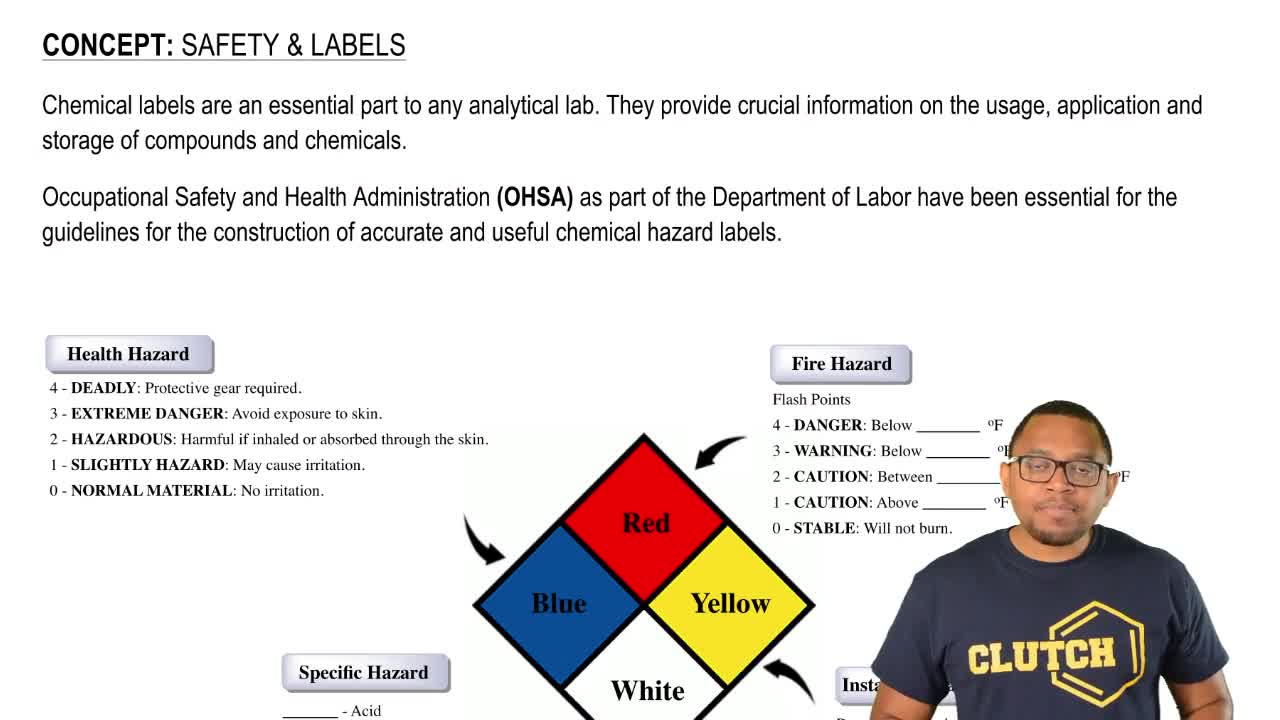
 05:13
05:13