Skip to main content
Analytical Chemistry
My Course
Learn
Exam Prep
AI Tutor
Study Guides
Flashcards
Explore
Try the app
My Course
Learn
Exam Prep
AI Tutor
Study Guides
Flashcards
Explore
Try the app
Back
SI Units definitions
You can tap to flip the card.
Kilogram
You can tap to flip the card.
👆
Kilogram
Standard unit for measuring mass, essential for quantifying substances in analytical chemistry.
Track progress
Control buttons has been changed to "navigation" mode.
1/15
Related flashcards
Related practice
Recommended videos
SI Units quiz
SI Units
15 Terms
SI Units
1. Chemical Measurements
5 problems
Topic
Metric Prefixes
1. Chemical Measurements
5 problems
Topic
1. Chemical Measurements - Part 1 of 2
4 topics
12 problems
Chapter
1. Chemical Measurements - Part 2 of 2
1 topic
3 problems
Chapter
Guided course
03:34
SI Units vs. Derived Units
2023
views
19
rank
Terms in this set (15)
Hide definitions
Kilogram
Standard unit for measuring mass, essential for quantifying substances in analytical chemistry.
Meter
Fundamental unit for measuring length, forming the basis for spatial measurements in experiments.
Second
Primary unit for measuring time, crucial for rate and kinetic studies in chemical processes.
Kelvin
Absolute temperature scale used in scientific calculations, avoiding negative values for thermodynamic work.
Mole
Represents a specific quantity of particles, central to stoichiometry and chemical equations.
Ampere
Unit for electrical current, defined as charge flow per second, vital in electrochemistry.
Hertz
Unit for frequency, expressed as cycles per second, often used in electromagnetic spectrum analysis.
Newton
Unit for force, derived from mass, length, and time, foundational in pressure and energy calculations.
Pascal
Unit for pressure, defined as force per unit area, commonly used instead of atmospheres in SI.
Joule
Unit for energy, work, or heat, applied in thermodynamics and calculations involving enthalpy or entropy.
Coulomb
Unit for electrical charge, representing the quantity of electricity transported by one ampere in one second.
Watt
Unit for power, indicating the rate of energy transfer or work done per second.
Voltage
Unit for electric potential difference, essential for understanding energy changes in electrochemical cells.
Stoichiometry
Branch of chemistry focused on quantitative relationships between reactants and products using SI units.
Gibbs Free Energy
Thermodynamic quantity predicting reaction spontaneity, often calculated using joules in SI.
 BackBack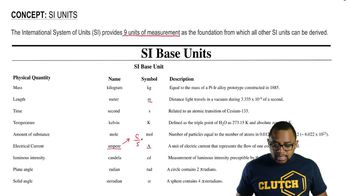
 03:34
03:34