Pearson+ LogoPearson+ Logo

The End Point quiz #1 Flashcards

Back
The End Point quiz #1
Control buttons has been changed to "navigation" mode.
1/10
  • What is the purpose of an indicator in a titration?

    The purpose of an indicator in a titration is to signal the endpoint by changing color, which helps estimate when the reaction is complete, such as when the moles of acid equal the moles of base in acid-base titrations or when a significant change in potential occurs in redox titrations.
  • What is the function of an indicator in a titration?

    The function of an indicator in a titration is to undergo a visible color change at or near the endpoint, allowing the experimenter to detect when the titration reaction is complete.
  • What is the end point of a titration?

    The endpoint of a titration is the stage at which the indicator changes color, signaling that the titration reaction is complete or nearly complete. In acid-base titrations, this typically corresponds to the equivalence point where moles of acid equal moles of base, while in redox titrations, it corresponds to a significant change in solution potential.
  • How does an indicator signal the endpoint in a titration?

    An indicator signals the endpoint in a titration by undergoing a change in oxidation state (in redox titrations) or a change in protonation state (in acid-base titrations), resulting in a visible color change that marks the completion of the reaction.
  • How does the titrant affect the solution's potential during a redox titration?

    The titrant interacts with the indicator, either oxidizing or reducing it, which alters the solution's potential. This change in potential can cause the indicator to change color, signaling the endpoint.
  • What is the significance of the indicator's transition range in a redox titration?

    The indicator's transition range should overlap with the sharpest increase in potential on the titration curve. This ensures the color change occurs near the true endpoint for accurate results.
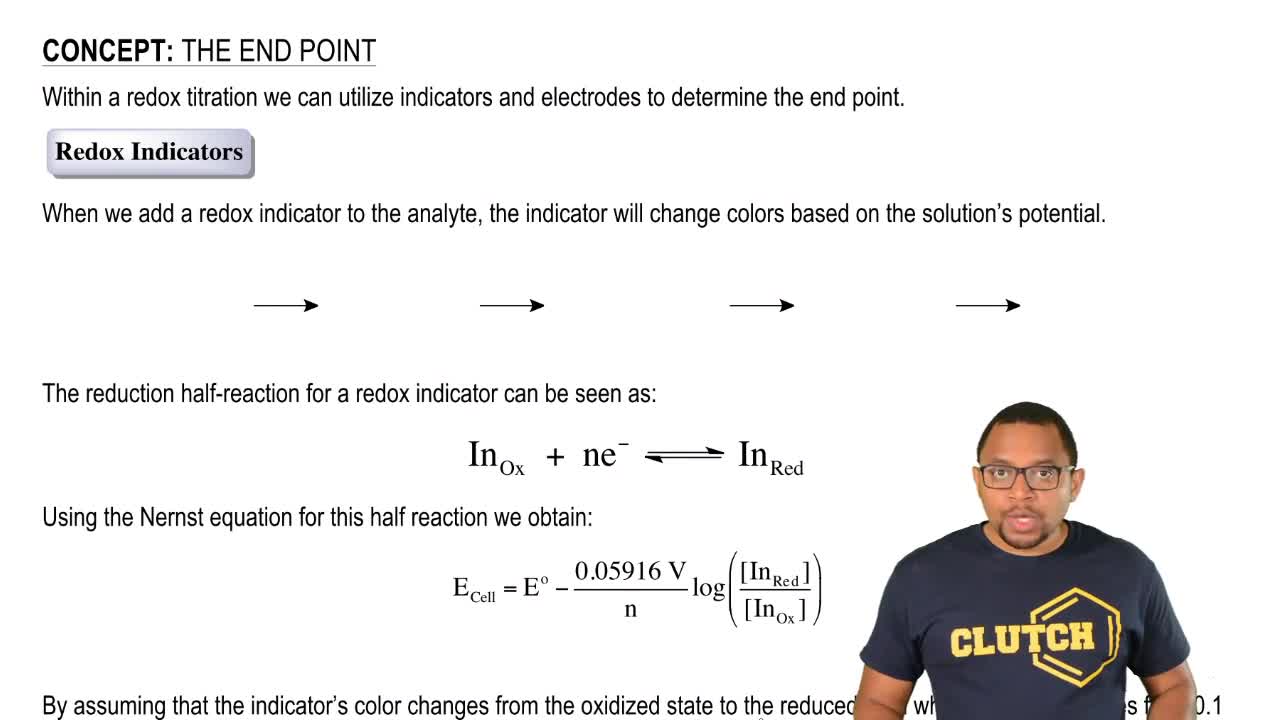
  • How is the Nernst equation used in the context of redox indicators?

    The Nernst equation relates the cell potential to the ratio of reduced and oxidized forms of the indicator under non-standard conditions. It helps predict when the indicator will change color based on the solution's potential.
  • Why is a range of -1 to +1 for the log ratio of reduced to oxidized indicator forms important?

    This range ensures that the concentrations of the reduced and oxidized forms do not differ by more than a factor of 10. It allows the indicator to function effectively within its color change range.
  • What role does a Gran plot play in determining the endpoint of a titration?

    A Gran plot uses the maximum value of the first derivative of potential versus volume to pinpoint the endpoint. This method provides a more precise determination than relying solely on color change.
  • Why might one indicator be preferred over another in a redox titration?

    An indicator is preferred if its color change occurs within the region of the titration curve that shows the greatest increase in potential. This alignment ensures the endpoint is detected as accurately as possible.