What is the main purpose of using metric prefixes in analytical chemistry?
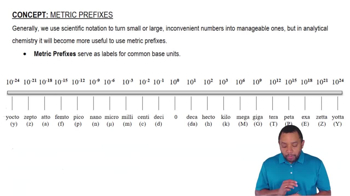
Metric prefixes are used to convert very large or very small numbers into more manageable values for easier understanding and calculation.
How do metric prefixes relate to base units?
Metric prefixes serve as labels that are placed in front of common base units, such as meters or liters, to indicate a specific multiple or fraction of the base unit.
What is the base unit exponent in the metric prefix chart?
The base unit exponent in the metric prefix chart is 10^0.
What is the value of the prefix 'kilo'?
The prefix 'kilo' represents a value of 10^3.
What is the value of the prefix 'micro'?
The prefix 'micro' represents a value of 10^-6.
What is the typical range of metric prefixes used in analytical chemistry?
In analytical chemistry, metric prefixes range from 10^-24 to 10^24.
Why is it important to memorize the metric prefix chart in analytical chemistry?
It is important because metric prefixes are frequently used in calculations and conversions, so knowing them helps solve problems efficiently.
What does the multiplier chart for metric prefixes display?
The multiplier chart displays the exponent value, the name of the metric prefix, and its symbol.
How is the number one used in metric prefix conversions?
The number one is always associated with the metric prefix when converting, such as 1 kilometer equals 10^3 meters.
What is the prefix for 10^-24?
The prefix for 10^-24 is 'yocto'.
What is the prefix for 10^24?
The prefix for 10^24 is 'yotta'.
Why do analytical chemists use a wider range of metric prefixes than usual?
Analytical chemistry requires high precision, so a wider range of prefixes is needed to express extremely large or small quantities.
Give an example of a metric prefix conversion involving liters.
1 microliter equals 10^-6 liters.
What is the significance of 10^0 in the metric prefix chart?
10^0 represents the base unit without any prefix, such as 1 meter or 1 liter.
How are metric prefixes used in word problems in analytical chemistry?
Metric prefixes are used to simplify calculations by converting values to more manageable numbers, which is essential for solving word problems.
 Back
Back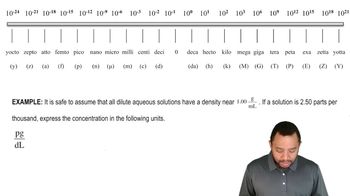
 03:03
03:03