 Back
BackAnalytical Chemistry: Chemical Measurements
 03:34
03:34
Terms in this set (20)
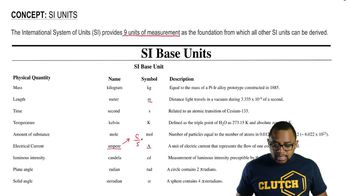
Mass (kilogram, kg), Length (meter, m), Time (second, s), Temperature (kelvin, K), Amount of substance (mole, mol), Electrical current (ampere, A), and Luminous intensity (candela, cd).
Molarity (M) = moles of solute per liter of solution.
Molality (m) = moles of solute per kilogram of solvent.
Weight percent = (mass of solute / mass of solution) × 100
Volume percent = (volume of solute / volume of solution) × 100
Weight/volume percent = (mass of solute in grams / volume of solution in mL) × 100
M1V1 = M2V2, where M1 and V1 are the molarity and volume before dilution, and M2 and V2 are after dilution.
Metric prefixes label common base units to simplify expressing very large or small quantities, e.g., nano (10-9), micro (10-6), kilo (103).
Calculate moles of solute from mass and molar mass, then divide by volume of solution in liters.
Mole fraction is the ratio of moles of one component to total moles; it can be used with density to calculate molality and molarity.
Use balanced chemical equations to relate moles of reactants and products to find unknown quantities.
A chemical analysis method involving measuring the mass of an isolated product to determine the amount of analyte.
Convert ppm to mass per volume, then to moles using molar mass, and finally divide by volume in liters.
V2 = V1 + volume of solvent added
Use percent composition and density to find mass of solute, convert to moles, then calculate molarity considering ion stoichiometry.
Use moles of titrant and volume to find moles of analyte, then divide sample mass by moles to get molar mass.
Use the dilution equation M1V1 = M2V2 to find the new molarity after dilution.
The number of particles equal to the number of atoms in 0.012 kg of Carbon-12 (~6.022 × 10²³).
Candela (cd) is the SI base unit for luminous intensity.
Molality = moles of solute / kilograms of solvent.
The kelvin is defined by the triple point of water at 273.15 K and absolute zero at 0 K.