What is the term for the growth of new blood vessels?
The growth of new blood vessels is called angiogenesis.
What are alternative routes of blood supply called, and how are they formed?
Alternative routes of blood supply are called collateral channels, and they are often formed by anastomoses, which are the merging points of blood vessels that provide alternative pathways for blood to reach the same destination if a vessel is compromised.
Why do we focus on convergence points rather than divergence points when studying collateral channels?
Convergence points, or anastomoses, are where blood vessels merge to form alternative pathways to the same destination. Divergence points often supply different areas and do not necessarily create collateral channels.
What is the significance of anastomoses in joints like the elbow and knee?
Anastomoses in these joints provide alternative blood pathways when vessels are compressed during movement. This ensures continuous blood supply to tissues regardless of joint position.
What are end or terminal blood vessels, and why are they clinically important?
End or terminal blood vessels do not form anastomoses and thus lack collateral channels. Obstruction of these vessels can lead to tissue death because there are no alternative blood supply routes.
Which organs are supplied by end or terminal blood vessels, making them vulnerable to obstruction?
The kidneys, spleen, and retina are supplied by end or terminal blood vessels. Blockage in these vessels can quickly result in tissue death due to lack of collateral circulation.
Why is blockage of a vein generally less life-threatening than blockage of an artery?
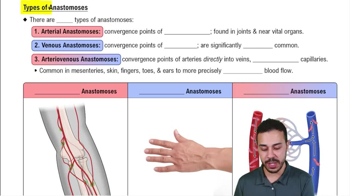
Venous anastomoses are much more common, providing extensive collateral channels in veins. This allows blood to bypass blockages more easily in veins than in arteries.
Where are arteriovenous anastomoses commonly found, and what is their function?
Arteriovenous anastomoses are common in the skin, fingers, toes, ears, and mesenteries. They allow blood to bypass capillaries, helping to reroute blood flow as needed.
How do arteriovenous anastomoses contribute to the risk of frostbite?
They enable blood to be rerouted away from the skin and extremities toward vital organs during cold conditions. This reduced blood flow to the extremities increases susceptibility to frostbite.
What is an example of an arteriovenous anastomosis in the digestive system?
The vascular shunt in the mesenteries is an example of an arteriovenous anastomosis. It connects arterioles directly to venules, bypassing capillaries when precapillary sphincters are constricted.
 Back
Back

 6:50
6:50