Back

Chemiosmosis quiz

Control buttons has been changed to "navigation" mode.
1/15
  • What is chemiosmosis?

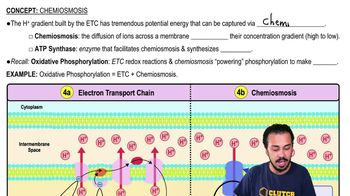
    Chemiosmosis is the diffusion of ions, specifically hydrogen ions, across a semipermeable membrane down their concentration gradient.
  • Which enzyme facilitates chemiosmosis?

    ATP synthase facilitates chemiosmosis.
  • What is the main function of ATP synthase?

    ATP synthase synthesizes ATP by using the energy from the movement of hydrogen ions down their concentration gradient.
  • How is the hydrogen ion concentration gradient established?

    The electron transport chain establishes the hydrogen ion concentration gradient by moving hydrogen ions into the intermembrane space.
  • Where does chemiosmosis occur in the mitochondria?

    Chemiosmosis occurs across the inner mitochondrial membrane.
  • What drives the diffusion of hydrogen ions during chemiosmosis?

    The diffusion is driven by the concentration gradient of hydrogen ions created by the electron transport chain.
  • What is the final electron acceptor in the electron transport chain?

    Oxygen gas is the final electron acceptor, which reacts to form water.
  • What process combines the electron transport chain and chemiosmosis?

    Oxidative phosphorylation combines the electron transport chain and chemiosmosis.
  • What is the main product of oxidative phosphorylation?

    The main product is ATP.
  • What role do NADH and FADH2 play in chemiosmosis?

    NADH and FADH2 donate electrons to the electron transport chain, helping to build the hydrogen ion gradient.
  • What happens to ADP during chemiosmosis?

    ADP is phosphorylated to form ATP.
  • Why is the hydrogen ion gradient considered to have potential energy?

    The gradient represents stored energy that can be used to power ATP synthesis as ions move down the gradient.
  • What is the significance of the 'ase' ending in ATP synthase?

    The 'ase' ending indicates that ATP synthase is an enzyme.
  • What is the relationship between chemiosmosis and aerobic cellular respiration?

    Chemiosmosis is a key part of aerobic cellular respiration, producing most of the ATP generated.
  • How does chemiosmosis contribute to energy production in cells?

    Chemiosmosis uses the energy from hydrogen ion diffusion to power ATP synthesis, providing energy for cellular activities.