Skip to main content
Anatomy & Physiology
My Course
Learn
Exam Prep
AI Tutor
Study Guides
Textbook Solutions
Flashcards
Explore
Try the app
My Course
Learn
Exam Prep
AI Tutor
Study Guides
Textbook Solutions
Flashcards
Explore
Try the app
Back
Classification of Joints definitions
4 students found this helpful
You can tap to flip the card.
Synarthrosis
You can tap to flip the card.
👆
Synarthrosis
A type of joint where skeletal elements are held closely together, allowing for no movement.
Track progress
Control buttons has been changed to "navigation" mode.
1/15
Related flashcards
Related practice
Recommended videos
Classification of Joints quiz #1
Classification of Joints
40 Terms
Classification of Joints quiz #2
Classification of Joints
24 Terms
Classification of Joints quiz #3
Classification of Joints
15 Terms
Classification of Joints
8. Joints
4 problems
Topic
Bruce
Structural Class: Fibrous Joints
8. Joints
4 problems
Topic
Bruce
8. Joints
6 topics
14 problems
Chapter
Bruce
Guided course
01:43
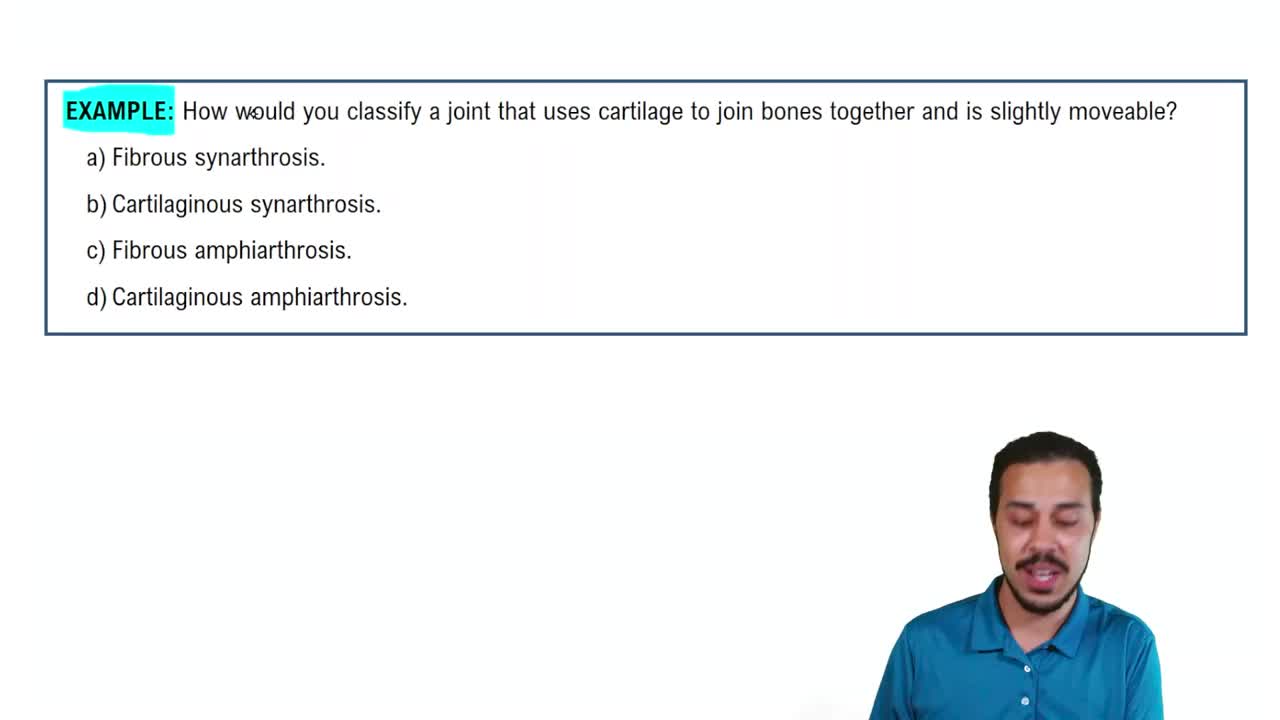
Classification of Joints Example 1
9458
views
189
rank
Guided course
01:33
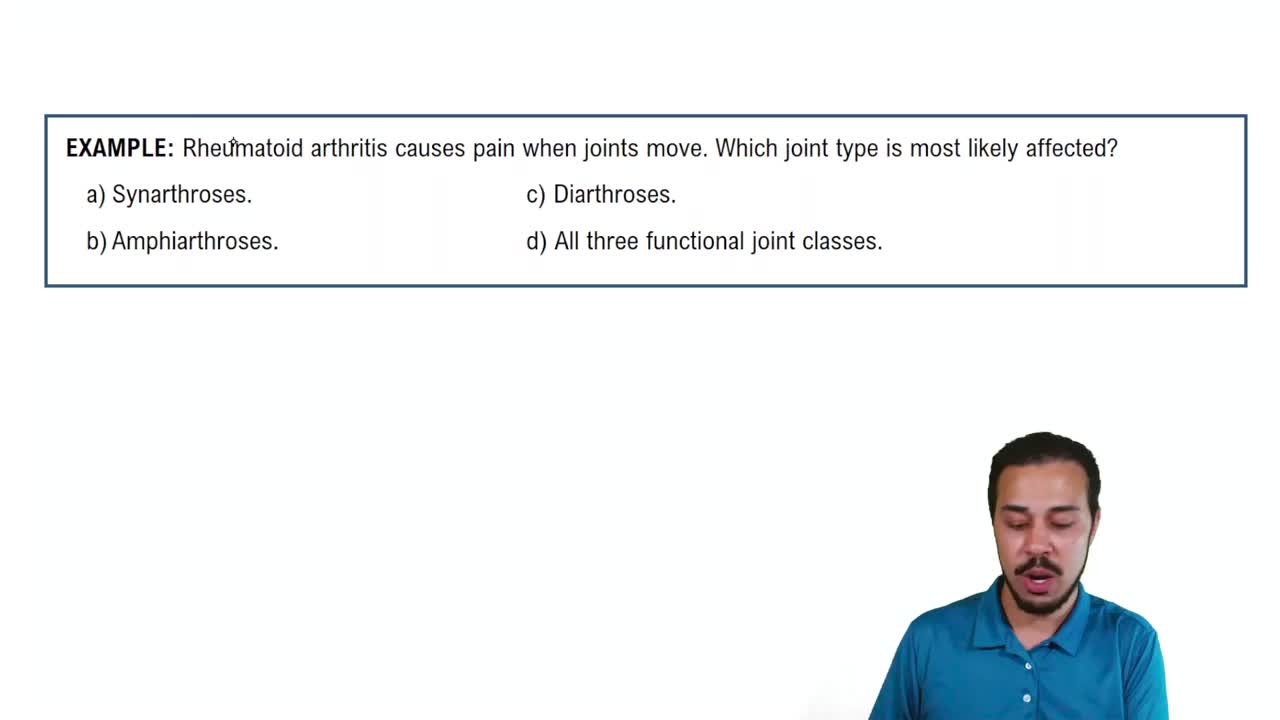
Classification of Joints Example 2
8107
views
143
rank
Guided course
01:19
Introduction to Classification of Joints
12544
views
190
rank
1
comments
Terms in this set (15)
Hide definitions
Synarthrosis
A type of joint where skeletal elements are held closely together, allowing for no movement.
Amphiarthrosis
A joint classification allowing for a little or average amount of movement, often found in the axial skeleton.
Diarthrosis
A joint classification allowing for dynamic and free movement, typically found in the appendicular skeleton.
Fibrous Joints
Joints bound by collagen fibers, providing stability but limited mobility.
Cartilaginous Joints
Joints bound by cartilage, offering stability with limited mobility.
Synovial Joints
Joints with a synovial cavity, allowing for dynamic movement.
Collagen Fibers
Fibers providing strength to fibrous joints, contributing to their stability.
Dense Irregular Connective Tissue
A type of tissue with irregular fiber arrangement, used in fibrous joints.
Hyaline Cartilage
A type of cartilage that can bind bones in cartilaginous joints.
Fibrocartilage
A type of cartilage found in cartilaginous joints, providing stability.
Synovial Cavity
A space within synovial joints that allows for movement.
Articular Capsule
A structure surrounding synovial joints, made of dense irregular connective tissue.
Sutures
Immovable joints in the skull, classified as synarthroses.
Intervertebral Joints
Joints in the spine allowing for limited movement, classified as amphiarthroses.
Shoulder Joint
An example of a synovial joint, allowing for a wide range of movement.
 BackBack
 01:43
01:43