Back

Covalent Bonds quiz

Control buttons has been changed to "navigation" mode.
1/15
  • What is a covalent bond?

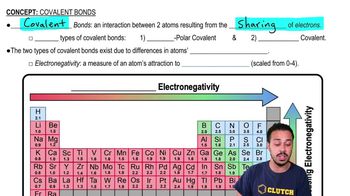
    A covalent bond is an interaction between two atoms that results from the sharing of electrons.
  • What does the term 'covalent' mean in chemistry?

    'Covalent' means sharing of electrons between atoms.
  • What are the two main types of covalent bonds?

    The two main types are nonpolar covalent bonds and polar covalent bonds.
  • What is electronegativity?

    Electronegativity is a measure of an atom's ability to attract electrons in a bond.
  • How does electronegativity influence the type of covalent bond formed?

    Differences in electronegativity between atoms determine whether a covalent bond is nonpolar (equal sharing) or polar (unequal sharing).
  • What characterizes a nonpolar covalent bond?

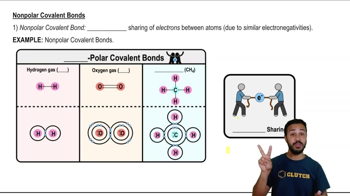
    A nonpolar covalent bond is characterized by equal sharing of electrons between atoms with similar or identical electronegativities.
  • Give an example of a molecule with nonpolar covalent bonds.

    Hydrogen gas (H2), oxygen gas (O2), and methane (CH4) are examples of molecules with nonpolar covalent bonds.
  • Why do H2 and O2 molecules have nonpolar covalent bonds?

    Because the atoms involved are identical and have the same electronegativity, leading to equal sharing of electrons.
  • Can nonpolar covalent bonds form between different atoms? Give an example.

    Yes, if the atoms have very similar electronegativities, such as in methane (CH4) between carbon and hydrogen.
  • What characterizes a polar covalent bond?

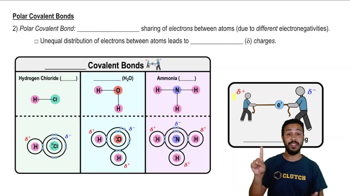
    A polar covalent bond is characterized by unequal sharing of electrons due to significant differences in electronegativity between the bonded atoms.
  • What is the result of unequal sharing of electrons in a polar covalent bond?

    It leads to partial charges on the atoms, with the more electronegative atom gaining a partial negative charge and the less electronegative atom gaining a partial positive charge.
  • Give an example of a molecule with polar covalent bonds.

    Water (H2O), hydrogen chloride (HCl), and ammonia (NH3) are examples of molecules with polar covalent bonds.
  • Why does the oxygen atom in water (H2O) have a partial negative charge?

    Because oxygen is much more electronegative than hydrogen, so it pulls the shared electrons closer, resulting in a partial negative charge.
  • How does electronegativity change across the periodic table?

    Electronegativity increases from left to right across a period and from bottom to top within a group.
  • Which element is the most electronegative, and why is this important?

    Fluorine is the most electronegative element, which is important because it pulls electrons more strongly than any other atom, influencing bond polarity.