Back

Endosymbiotic Theory quiz

Control buttons has been changed to "navigation" mode.
1/15
  • What does the endosymbiotic theory propose about mitochondria and chloroplasts?

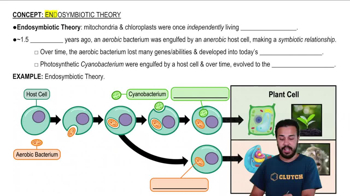
    It proposes that mitochondria and chloroplasts were once independently living bacteria that became organelles inside eukaryotic cells.
  • Approximately how many years ago did the aerobic bacterium get engulfed by the anaerobic host cell?

    About 1.5 billion years ago, the aerobic bacterium was engulfed by the anaerobic host cell.
  • What type of relationship was formed when the aerobic bacterium was engulfed by the host cell?

    A symbiotic relationship was formed, meaning both organisms benefited from each other.
  • Into what organelle did the engulfed aerobic bacterium eventually evolve?

    The aerobic bacterium evolved into today's mitochondria.
  • What type of bacterium was engulfed to eventually become the chloroplast?

    A photosynthetic cyanobacterium was engulfed and evolved into the chloroplast.
  • Which cells contain both mitochondria and chloroplasts as a result of endosymbiosis?

    Plant cells contain both mitochondria and chloroplasts.
  • What evidence supports the endosymbiotic theory regarding DNA structure?

    Mitochondria, chloroplasts, and prokaryotes all have small circular DNA.
  • What type of ribosomes are found in mitochondria, chloroplasts, and prokaryotes?

    They all contain small 70S ribosomes.
  • How do mitochondria, chloroplasts, and prokaryotes replicate?

    They replicate via a process called binary fission.
  • How many membranes do mitochondria and chloroplasts have?

    Both mitochondria and chloroplasts have two membranes: an inner and an outer membrane.
  • Why is the presence of two membranes in mitochondria and chloroplasts considered supporting evidence for the endosymbiotic theory?

    It is consistent with the engulfment process, where the host cell engulfs the bacterium, resulting in a second membrane.
  • What metabolic capability did the original aerobic bacterium possess?

    The aerobic bacterium used oxygen in its metabolism.
  • What metabolic capability did the original host cell possess before engulfing the bacterium?

    The host cell was anaerobic, meaning it did not use oxygen in its metabolism.
  • What process allowed for the development of complex life forms according to the endosymbiotic theory?

    The symbiotic relationship and evolution of mitochondria and chloroplasts enabled the development of complex life forms.
  • What is a key similarity between mitochondria, chloroplasts, and prokaryotes that supports the endosymbiotic theory?

    They all share similarities in DNA structure, ribosome type, and replication methods.