Skip to main content
Anatomy & Physiology
My Course
Learn
Exam Prep
AI Tutor
Study Guides
Textbook Solutions
Flashcards
Explore
Try the app
My Course
Learn
Exam Prep
AI Tutor
Study Guides
Textbook Solutions
Flashcards
Explore
Try the app
Back
Fascicle Arrangements quiz
You can tap to flip the card.
What is the relationship between muscle fiber length and contraction length?
You can tap to flip the card.
👆
What is the relationship between muscle fiber length and contraction length?
Muscle fiber length is proportional to the contraction length; longer fibers can shorten more.
Track progress
Control buttons has been changed to "navigation" mode.
1/9
Related flashcards
Related practice
Recommended videos
Fascicle Arrangements definitions
Fascicle Arrangements
15 Terms
Fascicle Arrangements quiz #1
Fascicle Arrangements
13 Terms
Fascicle Arrangements
10. Muscles
2 problems
Topic
Muscle Naming
10. Muscles
7 problems
Topic
Jason
10. Muscles
5 topics
11 problems
Chapter
Jason
8:11
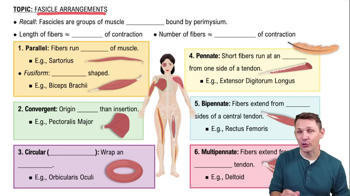
Fascicle Arrangements
8218
views
166
rank
2:29
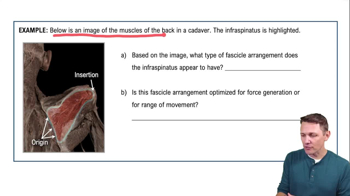
Fascicle Arrangements Example 1
5764
views
91
rank
Terms in this set (9)
Hide definitions
What is the relationship between muscle fiber length and contraction length?
Muscle fiber length is proportional to the contraction length; longer fibers can shorten more.
How does the total number of muscle fibers affect contraction strength?
The total number of muscle fibers is proportional to the strength of contraction; more fibers result in stronger contractions.
What is the characteristic shape of fusiform fascicle arrangement?
Fusiform fascicle arrangement is spindle-shaped, wider in the middle than at the ends.
What is the main feature of convergent fascicle arrangement?
Convergent fascicle arrangement has a broad origin and converges at a smaller insertion point.
What is the function of circular fascicle arrangements?
Circular fascicle arrangements, or sphincters, surround openings and contract to close them.
What is the defining characteristic of pennate fascicle arrangements?
Pennate fascicle arrangements have fibers running at angles to a central tendon, resembling a feather.
What is the difference between unipennate and bipennate fascicle arrangements?
Unipennate muscles have fibers extending from one side of a tendon, while bipennate muscles have fibers extending from both sides of a central tendon.
What is the advantage of multipennate fascicle arrangements?
Multipennate arrangements allow for more muscle fibers, increasing contraction strength despite shorter contraction lengths.
Why do parallel fascicle arrangements allow significant shortening but limited force?
Parallel arrangements have long fibers running in parallel, allowing significant shortening but limited force due to fewer fibers.
 BackBack
 8:11
8:11