Back

Feedback Loops quiz #1

Control buttons has been changed to "navigation" mode.
1/37
  • What is an example of an unconditioned response?

    Salivating when food is in the mouth
  • Why are positive and negative controls important when analyzing patient lab results?

    Positive and negative controls are important to ensure the accuracy and reliability of lab results by providing a baseline for comparison and identifying any errors in the testing process.
  • What does an exchange typically involve?

    All of the above
  • The nurse should evaluate client outcomes at which time? a) Before treatment b) During treatment c) After treatment d) All of the above

    d) All of the above
  • What is the correct order of the stages of change? a) Precontemplation, Contemplation, Preparation, Action, Maintenance b) Contemplation, Precontemplation, Action, Maintenance, Preparation c) Action, Maintenance, Preparation, Precontemplation, Contemplation d) Maintenance, Action, Preparation, Contemplation, Precontemplation

    a) Precontemplation, Contemplation, Preparation, Action, Maintenance
  • What does addressing a priority problem involve?

    Addressing a priority problem involves identifying the most critical issue that needs immediate attention to prevent further complications.
  • What types of feedback can a feedback cycle involve?

    It can be either positive or negative
  • What is a key mechanism involved in internal feedback?

    A key mechanism involved in internal feedback is the regulation of physiological processes to maintain homeostasis.
  • What is the best example of a conditioned reinforcer?

    Money
  • What is an example of an unconditioned stimulus?

    Food in the mouth
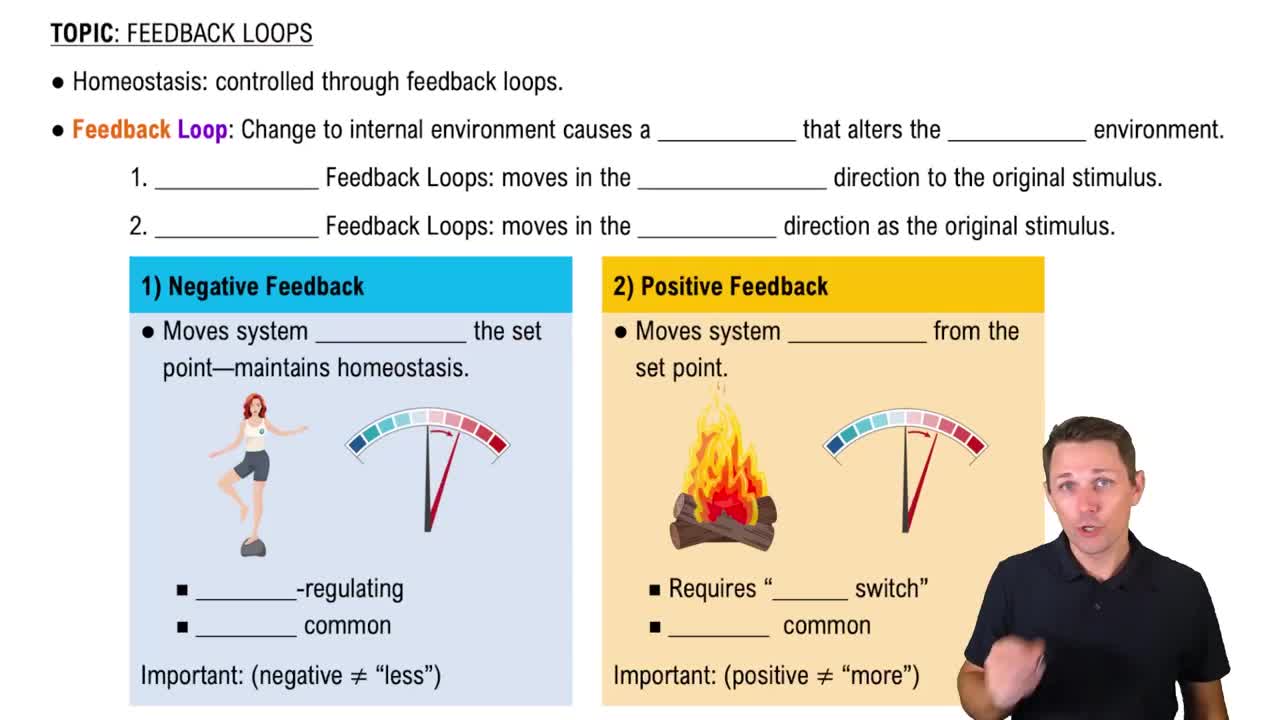
  • Which type of feedback loop is used to complete a process once it is triggered? a) Negative feedback loop b) Positive feedback loop c) Neutral feedback loop d) Cyclical feedback loop

    b) Positive feedback loop
  • Which process produces the acquisition of a conditioned response?

    Classical conditioning
  • How does feedback inhibition help the body maintain homeostasis?

    Feedback inhibition helps maintain homeostasis by regulating enzyme activity, preventing overproduction of substances, and ensuring balance within the body's systems.
  • What is an example of a learned response?

    Feeling anxious before a test
  • What is the purpose of a control in an experiment?

    The purpose of a control in an experiment is to provide a standard for comparison, ensuring that the results are due to the variable being tested and not other factors.
  • What is an example of an unconditioned response?

    Salivating when food is in the mouth
  • How does feedback regulation regulate enzyme activity?

    Feedback regulation controls enzyme activity by using the end product of a pathway to inhibit an enzyme involved in its production, thus preventing overproduction.
  • What is the correct order of steps in controlling?

    Setting standards, Measuring performance, Comparing with standards, Taking corrective action
  • What is not a part of a contingency contract?

    Random rewards
  • What is the most accurate statement about feedback mechanisms?

    Negative feedback stabilizes systems
  • What is an example of an unconditioned response?

    Salivating when food is in the mouth
  • What is the most accurate statement about feedback loops?

    Negative feedback loops help maintain homeostasis
  • What is the difference between voluntary and involuntary responses?

    Voluntary responses are consciously controlled actions, while involuntary responses occur automatically without conscious control.
  • In classical conditioning, what is the role of the conditioned stimulus?

    In classical conditioning, the conditioned stimulus is a previously neutral stimulus that, after association with an unconditioned stimulus, triggers a conditioned response.
  • What is correct about a between-subjects design?

    Participants are randomly assigned to different conditions
  • According to Kohlberg’s theory, what is the focus of moral development at the pre-conventional level?

    At the pre-conventional level, moral development focuses on self-interest and avoiding punishment.
  • Which type of feedback loop assists the body in maintaining homeostasis? a) Positive feedback loop b) Negative feedback loop c) Neutral feedback loop d) Cyclical feedback loop

    b) Negative feedback loop
  • What is not true concerning the use of feedback?

    Feedback always leads to equilibrium
  • What does classical conditioning involve?

    It involves associating a neutral stimulus with an unconditioned stimulus
  • What is a typical effector in a feedback system?

    Muscle
  • What is a classic example of classical conditioning?

    A dog salivating when it hears a bell
  • What does the M checkpoint check during the cell cycle?

    The M checkpoint checks for proper chromosome alignment and attachment to the spindle fibers before proceeding with mitosis.
  • Which type of feedback is more common in the body? a) Positive feedback b) Negative feedback c) Neutral feedback d) Cyclical feedback

    b) Negative feedback
  • What best describes a trigger in a feedback loop?

    The initial stimulus that starts the loop
  • What is the sequence of a successful communication process?

    Encoding, Transmission, Decoding, Feedback
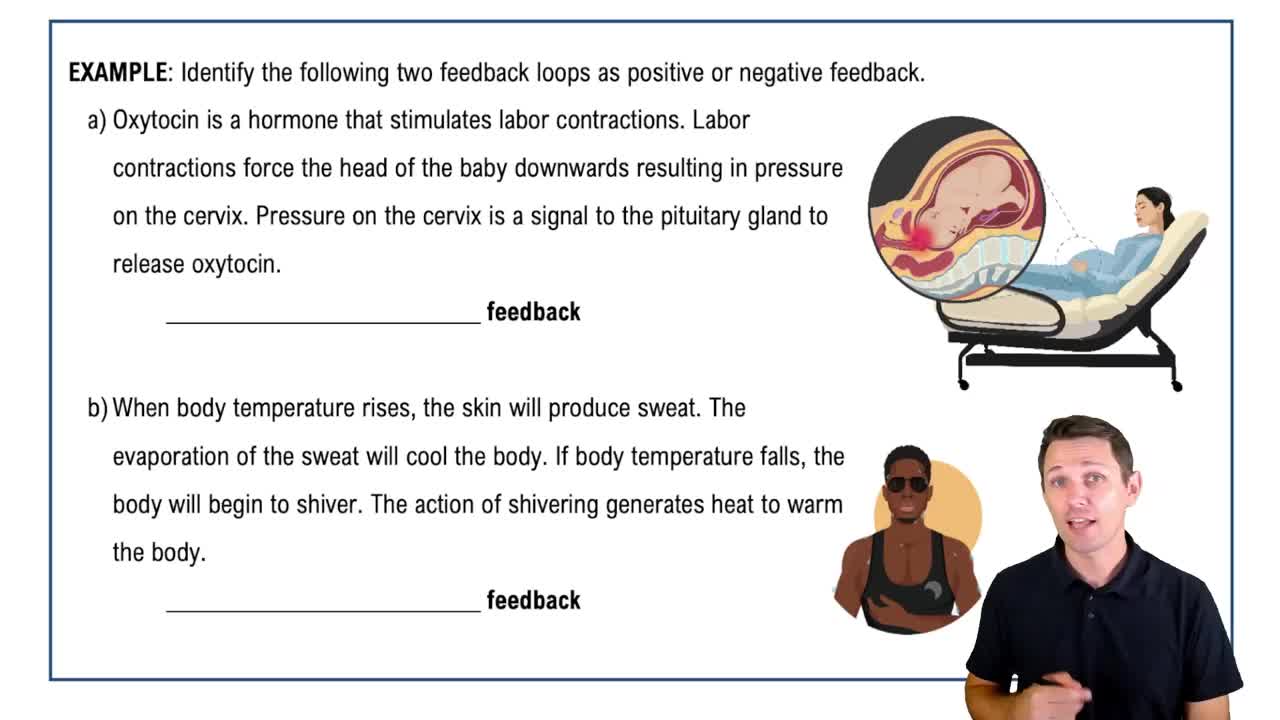
  • Which situation is an example of a feedback system in the body that maintains homeostasis? a) Sweating to cool down the body b) Shivering to generate heat c) Releasing insulin to lower blood glucose d) All of the above

    d) All of the above
  • What does operant conditioning involve?

    Reinforcing or punishing behaviors