Skip to main content
Anatomy & Physiology
My Course
Learn
Exam Prep
AI Tutor
Study Guides
Textbook Solutions
Flashcards
Explore
Try the app
My Course
Learn
Exam Prep
AI Tutor
Study Guides
Textbook Solutions
Flashcards
Explore
Try the app
Back
Gene Therapy quiz
You can tap to flip the card.
What does the acronym CRISPR stand for?
You can tap to flip the card.
👆
What does the acronym CRISPR stand for?
CRISPR stands for clusters of regularly interspaced short palindromic repeats.
Track progress
Control buttons has been changed to "navigation" mode.
1/15
Related flashcards
Related practice
Recommended videos
Gene Therapy definitions
Gene Therapy
15 Terms
Gene Therapy
29. Heredity
3 problems
Topic
Genetic Disorders
29. Heredity
3 problems
Topic
29. Heredity
5 topics
9 problems
Chapter
Bruce
Guided course
07:43
CRISPR CAS
326
views
2
rank
Terms in this set (15)
Hide definitions
What does the acronym CRISPR stand for?
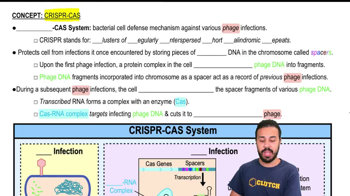
CRISPR stands for clusters of regularly interspaced short palindromic repeats.
What is the natural function of the CRISPR-Cas system in bacteria?
The CRISPR-Cas system acts as a defense mechanism against phage infections in bacteria.
What are spacers in the context of the CRISPR-Cas system?
Spacers are small fragments of phage DNA stored in the bacterial chromosome as a record of previous infections.
How are spacers incorporated into the bacterial chromosome?
After a phage infection, degraded phage DNA fragments can be incorporated into the chromosome as spacers.
What happens during a subsequent phage infection in a bacterium with the CRISPR-Cas system?
The bacterium transcribes spacer DNA into RNA, which forms a complex with the Cas enzyme to target and cleave the phage DNA.
What role does the Cas enzyme play in the CRISPR-Cas system?
The Cas enzyme forms a complex with RNA and cleaves the infecting phage DNA to inactivate it.
How does the RNA in the Cas complex guide the enzyme?
The RNA sequence is complementary to the phage DNA, guiding the Cas enzyme to the correct target for cleavage.
Why is the CRISPR-Cas system considered adaptive immunity?
It adapts by storing DNA from previous infections, allowing bacteria to defend against specific phages in the future.
How is the CRISPR-Cas system passed to future generations of bacteria?
Because it is part of the chromosome, the CRISPR system is replicated and inherited by future generations.
What is the main purpose of the CRISPR-Cas system in bacteria?
Its main purpose is to protect bacteria from phage infections by inactivating phage DNA.
What happens to phage DNA during the first infection in the CRISPR-Cas system?
Phage DNA is degraded into fragments, some of which are incorporated as spacers in the chromosome.
What is formed when spacer RNA combines with the Cas enzyme?
A Cas RNA complex is formed, which targets and cleaves phage DNA during subsequent infections.
How does the CRISPR-Cas system ensure ongoing defense against specific phages?
By storing phage DNA as spacers, it allows bacteria to recognize and inactivate the same phage upon reinfection.
What type of immunity does the CRISPR-Cas system exemplify?
It exemplifies active humoral immunity in bacteria.
Why is genetic memory important in the CRISPR-Cas system?
Genetic memory allows bacteria to remember and defend against phages they have previously encountered.
 BackBack
 07:43
07:43