Skip to main content
Anatomy & Physiology
My Course
Learn
Exam Prep
AI Tutor
Study Guides
Textbook Solutions
Flashcards
Explore
Try the app
My Course
Learn
Exam Prep
AI Tutor
Study Guides
Textbook Solutions
Flashcards
Explore
Try the app
Back
General Blood Vessel Structure quiz
You can tap to flip the card.
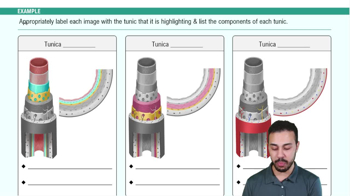
What are the three main structural layers (tunics) of most blood vessels?
You can tap to flip the card.
👆
What are the three main structural layers (tunics) of most blood vessels?
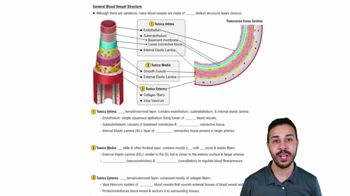
The three main tunics are the tunica intima, tunica media, and tunica externa.
Track progress
Control buttons has been changed to "navigation" mode.
1/15
Related flashcards
Related practice
Recommended videos
General Blood Vessel Structure definitions
General Blood Vessel Structure
15 Terms
General Blood Vessel Structure
19. The Blood Vessels
4 problems
Topic
Jason
Arteries
19. The Blood Vessels
6 problems
Topic
Jason
19. The Blood Vessels - Part 1 of 2
4 topics
10 problems
Chapter
Jason
19. The Blood Vessels - Part 2 of 2
4 topics
9 problems
Chapter
Bruce
Guided course
14:36
General Blood Vessel Structure
7840
views
142
rank
Guided course
4:24
General Blood Vessel Structure Example 1
5415
views
92
rank
Terms in this set (15)
Hide definitions
What are the three main structural layers (tunics) of most blood vessels?
The three main tunics are the tunica intima, tunica media, and tunica externa.
What is the primary function of the tunica intima?
The tunica intima minimizes friction and regulates capillary permeability.
What type of cells make up the endothelium of the tunica intima?
The endothelium is made up of simple squamous epithelial cells.
What is the function of the endothelium in blood vessels?
It provides a smooth surface to reduce friction and can secrete chemicals that affect vasoconstriction and vasodilation.
What are the two components of the subendothelium?
The subendothelium consists of a basement membrane and loose areolar connective tissue.
What is the role of the internal elastic lamina and where is it usually found?
The internal elastic lamina provides elasticity and is usually found in larger arteries near the heart.
What is the main component of the tunica media?
The tunica media is mainly composed of smooth muscle.
What is the function of the smooth muscle in the tunica media?
It regulates blood flow and pressure through vasoconstriction and vasodilation.
What is the external elastic lamina and where is it located?
The external elastic lamina is a layer of elastic tissue found mainly in larger arteries, separating the tunica media from the tunica externa.
Which blood vessels typically have the thickest tunica media?
Arteries usually have the thickest tunica media.
What is another name for the tunica externa?
The tunica externa is also called the adventitia.
What is the main structural component of the tunica externa?
It is mainly composed of collagen fibers.
What is the function of the vasa vasorum in blood vessels?
The vasa vasorum are tiny blood vessels that nourish the external tissues of the blood vessel wall.
Besides collagen fibers, what other structures can be found in the tunica externa?
The tunica externa can also contain nerves, lymphatic vessels, and sometimes elastic fibers.
How does the tunica externa help anchor blood vessels?
It provides structural support and helps anchor the blood vessel to surrounding tissues.
 BackBack

 14:36
14:36