Back

Immune Tolerance quiz

Control buttons has been changed to "navigation" mode.
1/15
  • What is immune tolerance?

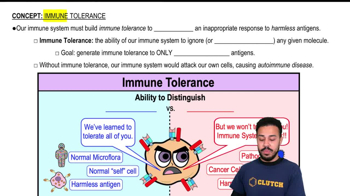
    Immune tolerance is the immune system's ability to ignore or tolerate harmless antigens while targeting harmful ones.
  • Why is immune tolerance important for the immune system?

    It prevents the immune system from attacking healthy cells and causing autoimmune diseases.
  • What can happen if immune tolerance fails?

    The immune system may attack the body's own healthy cells, leading to autoimmune diseases.
  • Where does central immune tolerance occur?

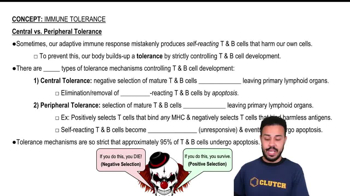
    Central immune tolerance occurs in the primary lymphoid organs: the thymus for T cells and the bone marrow for B cells.
  • What process is involved in central immune tolerance?

    Central immune tolerance involves negative selection, which eliminates self-reacting T and B cells.
  • Where does peripheral immune tolerance take place?

    Peripheral immune tolerance occurs in secondary lymphoid organs, such as lymph nodes.
  • What two types of selection are involved in peripheral immune tolerance?

    Peripheral immune tolerance involves both positive selection and negative selection of mature T and B cells.
  • What is negative selection in immune tolerance?

    Negative selection eliminates cells that react to self or harmless antigens, usually through apoptosis.
  • What is positive selection in immune tolerance?

    Positive selection promotes survival of cells that appropriately bind to MHC molecules.
  • Approximately what percentage of T and B cells survive the tolerance mechanisms?

    Only about 5% of T and B cells survive; around 95% are eliminated during tolerance mechanisms.
  • What is the football analogy for immune tolerance?

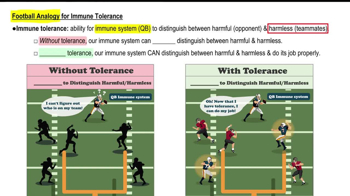
    The immune system is like a quarterback who must distinguish teammates (harmless antigens) from opponents (harmful antigens) to do its job properly.
  • What happens to self-reacting T and B cells during central tolerance?

    They are eliminated by apoptosis before leaving the primary lymphoid organs.
  • What does it mean if a cell becomes anergic during peripheral tolerance?

    It means the cell becomes unresponsive and will eventually undergo apoptosis.
  • Why is negative selection considered 'negative'?

    Because it results in the elimination or death of cells that bind to self or harmless antigens.
  • What is the main goal of immune tolerance mechanisms?

    To ensure that only immune cells that target harmful antigens survive, while those that could attack harmless or self-antigens are eliminated.