Skip to main content
Anatomy & Physiology
My Course
Learn
Exam Prep
AI Tutor
Study Guides
Textbook Solutions
Flashcards
Explore
Try the app
My Course
Learn
Exam Prep
AI Tutor
Study Guides
Textbook Solutions
Flashcards
Explore
Try the app
Back
Inner Layer of the Eyeball definitions
You can tap to flip the card.
Retina
You can tap to flip the card.
👆
Retina
The inner layer of the eye responsible for converting light into neural signals for the brain.
Track progress
Control buttons has been changed to "navigation" mode.
1/15
Related flashcards
Related practice
Recommended videos
Inner Layer of the Eyeball quiz
Inner Layer of the Eyeball
10 Terms
Inner Layer of the Eyeball
15. The Special Senses
2 problems
Topic
The Lens and Focusing Light on the Retina
15. The Special Senses
2 problems
Topic
15. The Special Senses
8 topics
13 problems
Chapter
Bruce
5:04
Structures of the Retina
3554
views
58
rank
4:21
Inner Layer of the Eyeball Example 4
2932
views
45
rank
3:04
Inner Layer of the Eyeball Example 1
3452
views
72
rank
Terms in this set (15)
Hide definitions
Retina
The inner layer of the eye responsible for converting light into neural signals for the brain.
Photoreceptors
Cells in the retina that detect light and initiate the process of phototransduction.
Rods
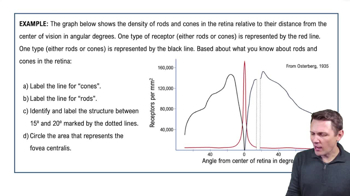
Photoreceptors sensitive to low light, providing grayscale vision and aiding peripheral vision.
Cones
Photoreceptors requiring bright light, enabling color vision and high visual acuity.
Macula Lutea
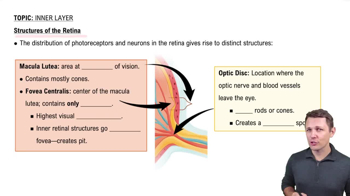
A region in the retina rich in cones, crucial for high visual acuity.
Fovea Centralis
The center of the macula lutea, providing the clearest vision due to its high concentration of cones.
Optic Disc
The point where the optic nerve exits the eye, creating a natural blind spot.
Pigmented Layer
A single cell layer in the retina that supports photoreceptors and absorbs excess light.
Neural Layer
The part of the retina containing photoreceptors and neurons for transmitting visual signals.
Bipolar Cells
Cells in the retina that transmit signals from photoreceptors to ganglion cells.
Ganglion Cells
Retinal cells that generate action potentials and form the optic nerve.
Amacrine Cells
Retinal cells involved in the initial processing of visual information.
Horizontal Cells
Retinal cells that facilitate communication between photoreceptors and bipolar cells.
Phototransduction
The process of converting light into an electrochemical signal in the retina.
Blind Spot
An area in the visual field where no image is detected due to the absence of photoreceptors.
 BackBack
 5:04
5:04