Skip to main content
Anatomy & Physiology
My Course
Learn
Exam Prep
AI Tutor
Study Guides
Textbook Solutions
Flashcards
Explore
Try the app
My Course
Learn
Exam Prep
AI Tutor
Study Guides
Textbook Solutions
Flashcards
Explore
Try the app
Back
Introduction to Epithelial Tissue definitions
5 students found this helpful
You can tap to flip the card.
Epithelia
You can tap to flip the card.
👆
Epithelia
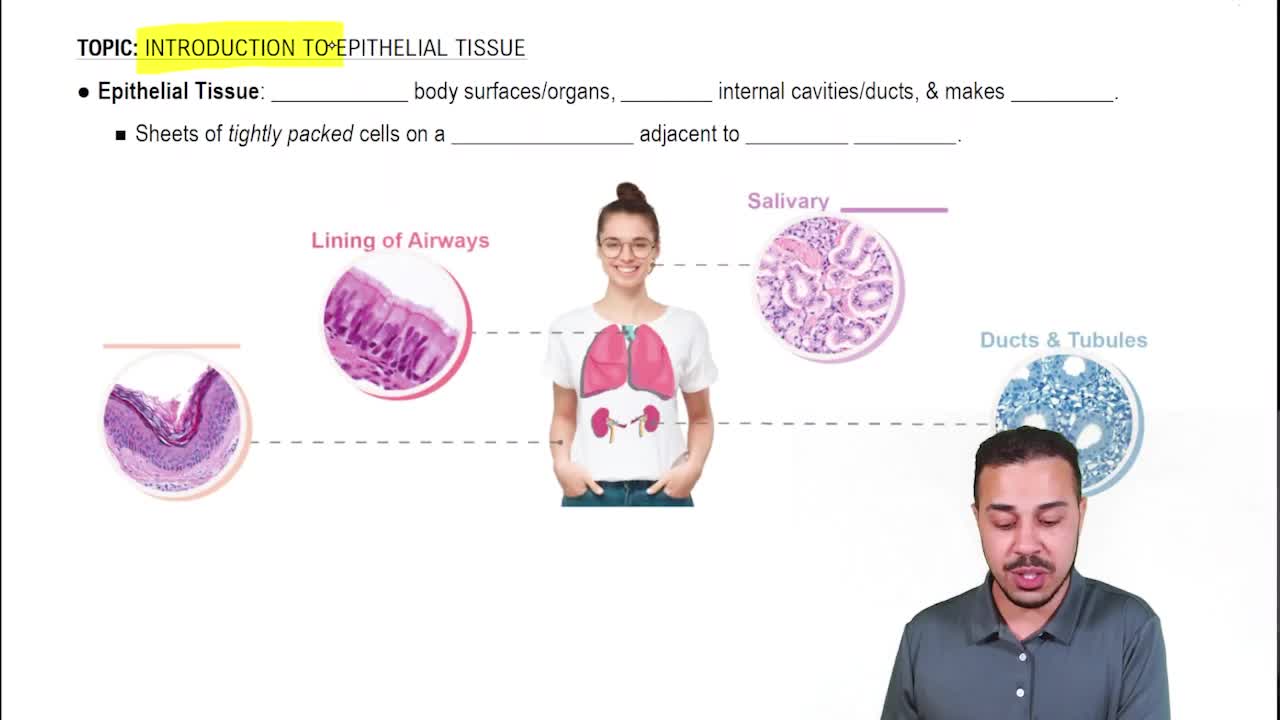
A type of tissue covering body surfaces, lining cavities, and forming glands, consisting of tightly packed cells in sheets.
Track progress
Control buttons has been changed to "navigation" mode.
1/15
Related flashcards
Related practice
Recommended videos
Introduction to Epithelial Tissue quiz #1
Introduction to Epithelial Tissue
40 Terms
Introduction to Epithelial Tissue quiz #2
Introduction to Epithelial Tissue
40 Terms
Introduction to Epithelial Tissue quiz #3
Introduction to Epithelial Tissue
40 Terms
Introduction to Epithelial Tissue
4. Tissues & Histology
3 problems
Topic
Characteristics of Epithelial Tissue
4. Tissues & Histology
3 problems
Topic
Bruce
4. Tissues & Histology - Part 1 of 2
9 topics
14 problems
Chapter
Bruce
4. Tissues & Histology - Part 2 of 2
12 topics
16 problems
Chapter
Bruce
07:25
Functions of Epithelial Tissue
16730
views
358
rank
03:40
Intro to Epithelia
19806
views
475
rank
05:24
Introduction to Epithelial Tissue Example 1
12967
views
265
rank
1
comments
Terms in this set (15)
Hide definitions
Epithelia
A type of tissue covering body surfaces, lining cavities, and forming glands, consisting of tightly packed cells in sheets.
Glandular Epithelium
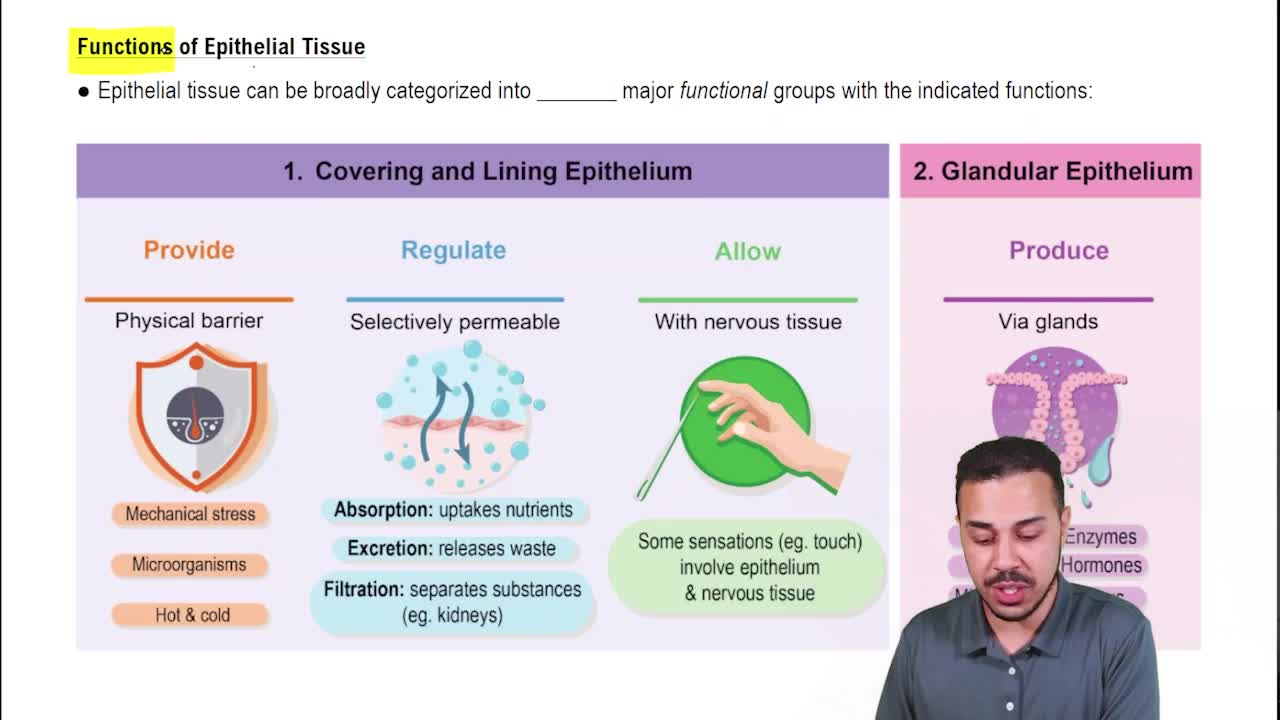
Specialized epithelial tissue forming glands that produce and release secretions like sweat and hormones.
Covering and Lining Epithelium
Epithelial tissue that covers body surfaces and lines internal cavities, providing protection and regulating transport.
Micrograph
An image taken through a microscope showing detailed structures, such as sheets of epithelial cells.
Open Space
The area adjacent to epithelial tissue, visible in micrographs, indicating the boundary where cells are tightly packed.
Protection
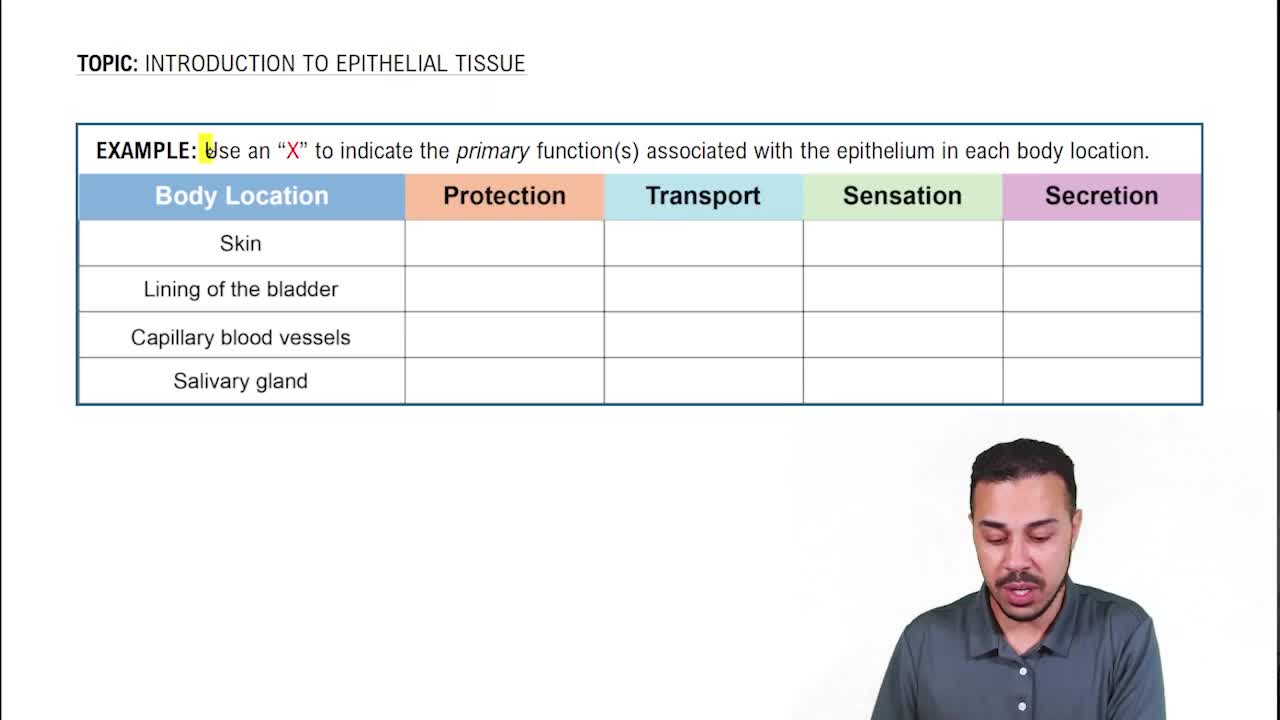
A function of epithelial tissue acting as a barrier against mechanical stress, microorganisms, and temperature extremes.
Selective Permeability
A property of epithelial tissue allowing selective transport of substances across its boundary.
Absorption
The uptake of nutrients by epithelial tissue, such as glucose absorption in the digestive system.
Excretion
The release of waste products from epithelial tissue, such as through urine.
Filtration
The process of separating substances, a key function of epithelial tissue in the kidneys.
Sensations
The detection of stimuli by epithelial tissue, which interacts with nervous tissue to process sensations like touch.
Salivary Glands
Glands formed by epithelial tissue in the mouth that produce and secrete saliva.
Ducts
Tubular structures lined by epithelial tissue, such as those found in kidneys, facilitating transport.
Tubules
Small tube-like structures lined with epithelial tissue, involved in transport and filtration in organs like kidneys.
Secretions
Products released by glandular epithelium, including sweat, saliva, and hormones.
 BackBack
 07:25
07:25