Skip to main content
Anatomy & Physiology
My Course
Learn
Exam Prep
AI Tutor
Study Guides
Textbook Solutions
Flashcards
Explore
Try the app
My Course
Learn
Exam Prep
AI Tutor
Study Guides
Textbook Solutions
Flashcards
Explore
Try the app
Back
Introduction to Hemodynamics quiz
You can tap to flip the card.
What factor decreases total peripheral resistance to blood flow: increased blood viscosity, increased vessel length, or increased vessel diameter?
You can tap to flip the card.
👆
What factor decreases total peripheral resistance to blood flow: increased blood viscosity, increased vessel length, or increased vessel diameter?
Increased vessel diameter would decrease total peripheral resistance to blood flow.
Track progress
Control buttons has been changed to "navigation" mode.
1/10
Related flashcards
Related practice
Recommended videos
Introduction to Hemodynamics definitions
Introduction to Hemodynamics
15 Terms
Introduction to Hemodynamics quiz #1
Introduction to Hemodynamics
10 Terms
Introduction to Hemodynamics
19. The Blood Vessels
7 problems
Topic
Jason
Anastomoses
19. The Blood Vessels
3 problems
Topic
19. The Blood Vessels - Part 1 of 2
4 topics
10 problems
Chapter
Jason
19. The Blood Vessels - Part 2 of 2
4 topics
9 problems
Chapter
Bruce
Guided course
2:29
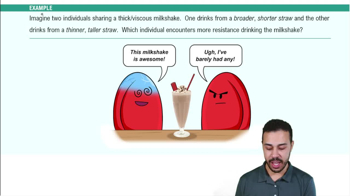
Introduction to Hemodynamics Example 3
2988
views
54
rank
Guided course
6:40
Relationship Between Blood Flow, Pressure, & Resistance
3921
views
63
rank
Guided course
6:24
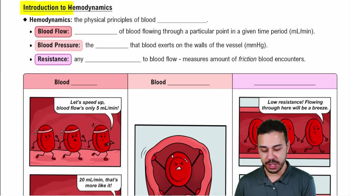
Hemodynamics
4545
views
98
rank
Terms in this set (10)
Hide definitions
What factor decreases total peripheral resistance to blood flow: increased blood viscosity, increased vessel length, or increased vessel diameter?
Increased vessel diameter would decrease total peripheral resistance to blood flow.
What factor causes an increase in peripheral resistance: decreased blood viscosity, decreased vessel length, or decreased vessel diameter?
Decreased vessel diameter will cause an increase in peripheral resistance.
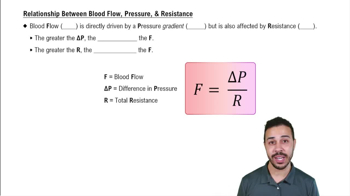
What is the relationship between blood flow and blood pressure gradient?
Blood flow is directly proportional to the blood pressure gradient.
How does blood viscosity affect resistance in the cardiovascular system?
Higher blood viscosity increases resistance in the cardiovascular system.
What role do arterioles play in regulating resistance?
Arterioles regulate resistance by vasoconstricting and vasodilating, affecting blood flow.
What is the primary factor that can be easily altered to change resistance in blood vessels?
Blood vessel diameter is the primary factor that can be easily altered to change resistance.
How does blood vessel length affect resistance?
Longer blood vessels increase resistance due to more opportunities for friction with vessel walls.
What is the effect of increased blood pressure gradient on blood flow?
Increased blood pressure gradient results in increased blood flow.
What is the relationship between blood flow and resistance?
Blood flow is inversely proportional to resistance.
How does the diameter of a blood vessel influence blood flow resistance?
A larger diameter decreases resistance, while a smaller diameter increases resistance.
 BackBack

 2:29
2:29