Pearson+ LogoPearson+ Logo
Back

Introduction to Hemodynamics quiz #1

Control buttons has been changed to "navigation" mode.
1/10
  • What is blood viscosity and how does it affect blood flow resistance in the cardiovascular system?

    Blood viscosity refers to the thickness of the blood. The greater the viscosity, the thicker the blood, which increases resistance to blood flow in the cardiovascular system. Higher viscosity makes it harder for blood to flow, while lower viscosity reduces resistance.
  • What is the typical time it takes for blood to circulate through the entire cardiovascular system, and what factors influence this circulation?

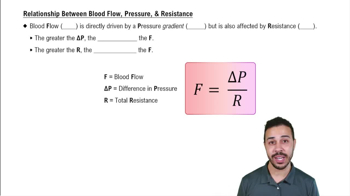
    The time it takes for blood to circulate through the entire cardiovascular system depends on blood flow, which is influenced by the blood pressure gradient and resistance. Blood flows from areas of high pressure to low pressure, and resistance is affected by blood viscosity, vessel length, and vessel diameter. The relationship is described by the equation: blood flow (F) = pressure gradient (ΔP) / resistance (R).
  • What does the term hemodynamics refer to in the context of the cardiovascular system?

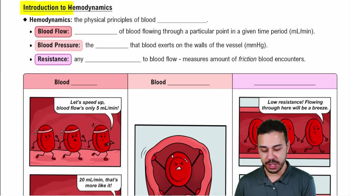
    Hemodynamics refers to the physical principles of blood circulation throughout the cardiovascular system. It focuses on the study of blood flow, blood pressure, and resistance.
  • How is blood flow typically measured in the cardiovascular system?

    Blood flow is usually measured in units of milliliters per minute. This indicates how many milliliters of blood pass through a particular point in the system within one minute.
  • Where in the cardiovascular system is blood pressure typically the highest and lowest?

    Blood pressure is highest in the arteries closest to the heart, around 120 mmHg. It is lowest in the large systemic veins, where it can be as low as about 2 mmHg.
  • What is peripheral resistance and where is it most commonly encountered?

    Peripheral resistance refers to the greatest amount of resistance encountered away from the heart, in the periphery of the body. It is most commonly encountered in the arterioles.
  • Why are arterioles sometimes called resistance vessels?

    Arterioles are called resistance vessels because they play a critical role in regulating resistance in the cardiovascular system. Their ability to vasoconstrict and vasodilate allows them to significantly alter resistance.
  • How does the length of a blood vessel affect resistance to blood flow?

    The longer the blood vessel, the more opportunities there are for blood to encounter friction with the vessel walls. This increased friction leads to higher resistance.
  • Which factor affecting resistance is most easily altered physiologically and why?

    Blood vessel diameter is the most easily altered factor because many blood vessels have smooth muscle in their walls. This muscle can contract or relax to change the vessel's diameter.
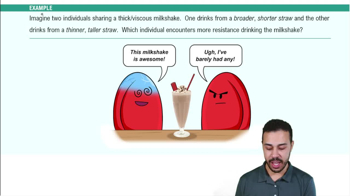
  • How does the analogy of drinking a thick milkshake with different straws help explain resistance in blood vessels?

    A thick milkshake flows slowly through a tall, narrow straw due to high resistance, similar to blood in a long, narrow vessel. In contrast, it flows quickly through a short, wide straw, illustrating how lower resistance allows easier flow.