What process is a component of the second line of defense?
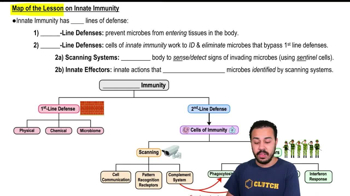
Phagocytosis
How does the innate nonspecific immune system respond to pathogens?
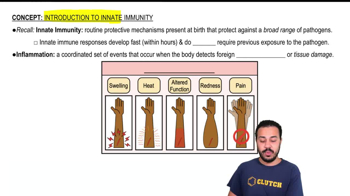
It responds rapidly within hours
What is the first link in the chain of infection?
Infectious agent
What is an example of an airborne precaution?
Wearing a mask
What is an example of a reaction that is not allergic?
Fever from infection
What does the nurse need to do when there is any indication of an allergic reaction in clients?
The nurse should immediately assess the client, stop any potential allergens, and provide appropriate interventions such as administering antihistamines or epinephrine if necessary.
Which two of the following statements regarding virulence factors are correct? a) They enhance the ability of pathogens to cause disease b) They are part of the host's immune response c) They can include toxins and enzymes d) They are always beneficial to the host
a) They enhance the ability of pathogens to cause disease, c) They can include toxins and enzymes
Which of the following is not considered a defense mechanism: skin, mucous membranes, antibodies, or hair?
Hair
What is the difference between innate and adaptive immunity?
Innate immunity is present at birth, responds rapidly, and does not require previous exposure to pathogens, while adaptive immunity develops over time, is specific to particular pathogens, and requires previous exposure.
What is an example of direct transmission of a pathogen?
Physical contact
What is not a reservoir of infection?
Sterile surgical instruments
Which innate internal defense works by interfering with viral replication?
Interferons
What is a true statement about innate immunity?
It provides a rapid response to a wide range of pathogens
Bacteriocins and defensins are types of what?
Antimicrobial peptides
What is an example of a specific (adaptive) immunity component rather than nonspecific (innate) immunity?
Antibodies
What is an example of a specific host defense rather than a nonspecific host defense?
Antibodies
Which population is most susceptible to helminth infections?
Immunocompromised individuals
How are the three lines of defense the same?
All three lines of defense work to protect the body from pathogens, though they operate at different stages and with different mechanisms.
What is the difference between innate and acquired immunity?
Innate immunity is present at birth and provides immediate, nonspecific defense, while acquired immunity develops after exposure to specific pathogens and provides long-term, specific protection.
Which component does not belong to the second line of defense in immunity?
Skin
What is the difference between natural and acquired immunity?
Natural immunity is the body's inherent ability to fight off pathogens, while acquired immunity is developed through exposure to specific pathogens or through vaccination.
When the body uses nonspecific immune defenses, what is it primarily relying on?
The body is primarily relying on innate immunity, which includes barriers like skin and mucous membranes, as well as responses like inflammation and phagocytosis.
What characteristic does not accurately describe innate immunity?
It is specific to certain pathogens
What is not part of the innate immune response?
Antibodies
A nurse is caring for four clients. Which client has the highest risk of infection? a) A healthy adult b) An elderly patient c) A child with a cold d) A patient with a compromised immune system
d) A patient with a compromised immune system
What is the most common route of viral entry in human infections? a) Skin contact b) Respiratory tract c) Digestive tract d) Bloodstream
b) Respiratory tract
Which of the following is a component of innate immunity?
Skin
What are defensins classified as?
Antimicrobial peptides
What is not part of the innate defense response? a) Skin b) Mucous membranes c) Antibodies d) Inflammation
c) Antibodies
What is not a characteristic of innate immunity?
Specific to pathogens
What is true regarding defense mechanisms?
Defense mechanisms include both innate and adaptive responses that protect the body from pathogens.
Which is a part of the innate immune defenses? a) Antibodies b) T-cells c) Skin d) Memory cells
c) Skin
Upon reexposure to a pathogen, how does the innate immune system respond?
The innate immune system responds in a similar manner to the first exposure, as it does not have memory capabilities.
How is the innate immune system best described?
It is nonspecific and rapid
Which type of defense guards against a broad range of pathogens? a) Innate immunity b) Adaptive immunity c) Specific immunity d) Acquired immunity
a) Innate immunity
Why does the human body need more than its skin to function as a barrier to infecting pathogens?
The skin acts as a physical barrier, but pathogens can enter through other routes like mucous membranes, requiring additional defenses like the immune system.
What symptom is not typically associated with an allergic reaction?
Fever
What does the body's second line of defense against pathogens consist of?
The second line of defense includes cells and mechanisms like phagocytes, inflammation, fever, and the interferon response.
Which component is not included in the second line of defense?